The encoding table
The encoding table is a pandas DataFrame, one row per (site, mutation_letter) combination, that says how a string genotype maps to its packed binary form. It is the load-bearing contract between gpmap-v2 and any package that builds models on top of it.
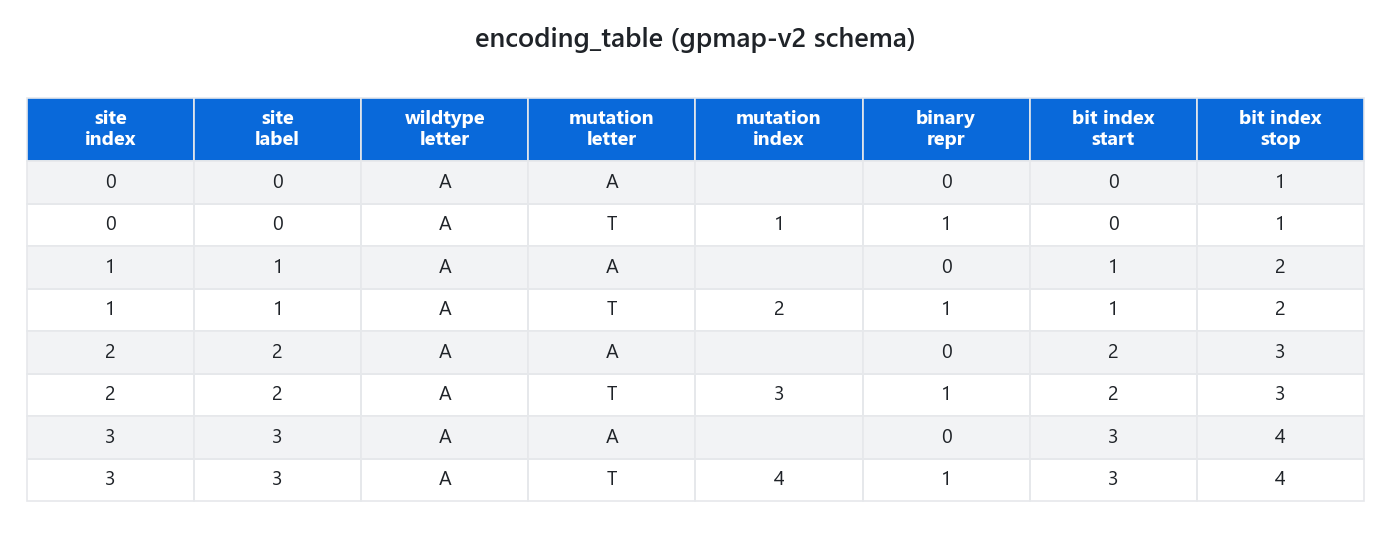
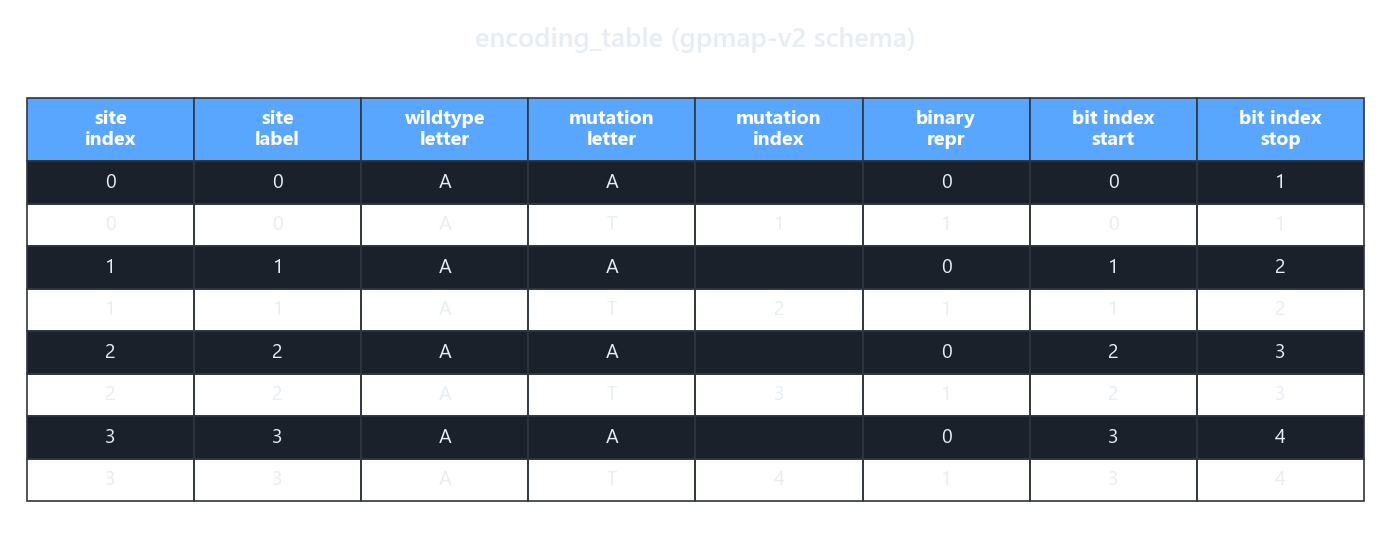
Schema
| Column | dtype | Nullable | Meaning |
|---|---|---|---|
site_index |
Int64 |
no | 0..L-1, position in the wildtype |
site_label |
string |
no | user-visible label, defaults to str(site_index) |
wildtype_letter |
string |
no | single character, the WT at site_index |
mutation_letter |
string |
yes (NaN on frozen sites) | the letter this row describes |
mutation_index |
Int64 |
yes (NaN on WT rows and frozen sites) | global mutation index starting at 1 |
binary_repr |
string |
no (empty on frozen sites) | unary-minus-one encoding, length = alphabet_size - 1 |
binary_index_start |
Int64 |
no | left edge of this site's slot in the concatenated binary |
binary_index_stop |
Int64 |
no | right edge (exclusive) |
Worked example
For wildtype="AX" and mutations={0: ["A","C","G"], 1: None} (site 1 frozen):
| site_index | site_label | wildtype_letter | mutation_letter | mutation_index | binary_repr | binary_index_start | binary_index_stop |
|---|---|---|---|---|---|---|---|
| 0 | "0" | "A" | "A" | <NA> |
"00" | 0 | 2 |
| 0 | "0" | "A" | "C" | 1 | "10" | 0 | 2 |
| 0 | "0" | "A" | "G" | 2 | "01" | 0 | 2 |
| 1 | "1" | "X" | <NA> |
<NA> |
"" | 2 | 2 |
Site 0 has alphabet size 3, so n_bits = 2. Site 1 is frozen and contributes 0 bits. The total n_bits for the map is 2.
Unary-minus-one encoding
Each active site contributes alphabet_size - 1 bits. The wildtype letter is the all-zero string. Each non-WT letter sets exactly one bit:
Letter at a site with alphabet ["A", "C", "G"] (WT=A) |
binary_repr |
|---|---|
| A | "00" |
| C | "10" |
| G | "01" |
The full binary representation of a genotype is the concatenation of the per-site binary_repr strings, in site_index order. binary_index_start and binary_index_stop give you the slice indices into that concatenation.
Reading from the encoding table
This is the canonical query pattern for downstream consumers like epistasis-v2: drop frozen-site rows and WT rows, then group by site_index to build the per-site mutation index used in the design matrix.
Legacy alias
The v1 schema had a column named genotype_index that was actually a site index. The v2 schema renames it to site_index. The old name is still available as a read-only alias for one minor version:
Writes only go to site_index. The alias issues a DeprecationWarning and will be removed in a future minor release.
Update your consumers
If you maintain a package that reads gpmap encoding tables, switch to site_index now. The alias is a transition aid, not a permanent feature.
Building one manually
For most uses you do not need to build the encoding table yourself; it is computed lazily by GenotypePhenotypeMap when you first access gpm.encoding_table. If you need it as a standalone artifact:
from gpmap import get_encoding_table

table = get_encoding_table(
    wildtype="AXG",
    mutations={0: ["A", "T"], 1: None, 2: ["G", "C"]},
)
Validating an externally-built table
from gpmap import validate_encoding_table

validate_encoding_table(table)  # raises SchemaError if anything is off
validate_encoding_table checks that all required columns are present, that site_index has no NaN, and that binary_index_stop agrees with the implied n_bits.
Going from strings to packed binary
from gpmap import genotypes_to_binary_packed

packed = genotypes_to_binary_packed(["ATG", "ATC"], table)  # shape (2, n_bits), dtype uint8
This is the fastest path from a list of genotype strings to the packed binary representation. Unknown letters raise UnknownLetterError. Under the hood this dispatches to the Rust genotypes_to_binary_packed kernel, parallelized over rows with rayon.
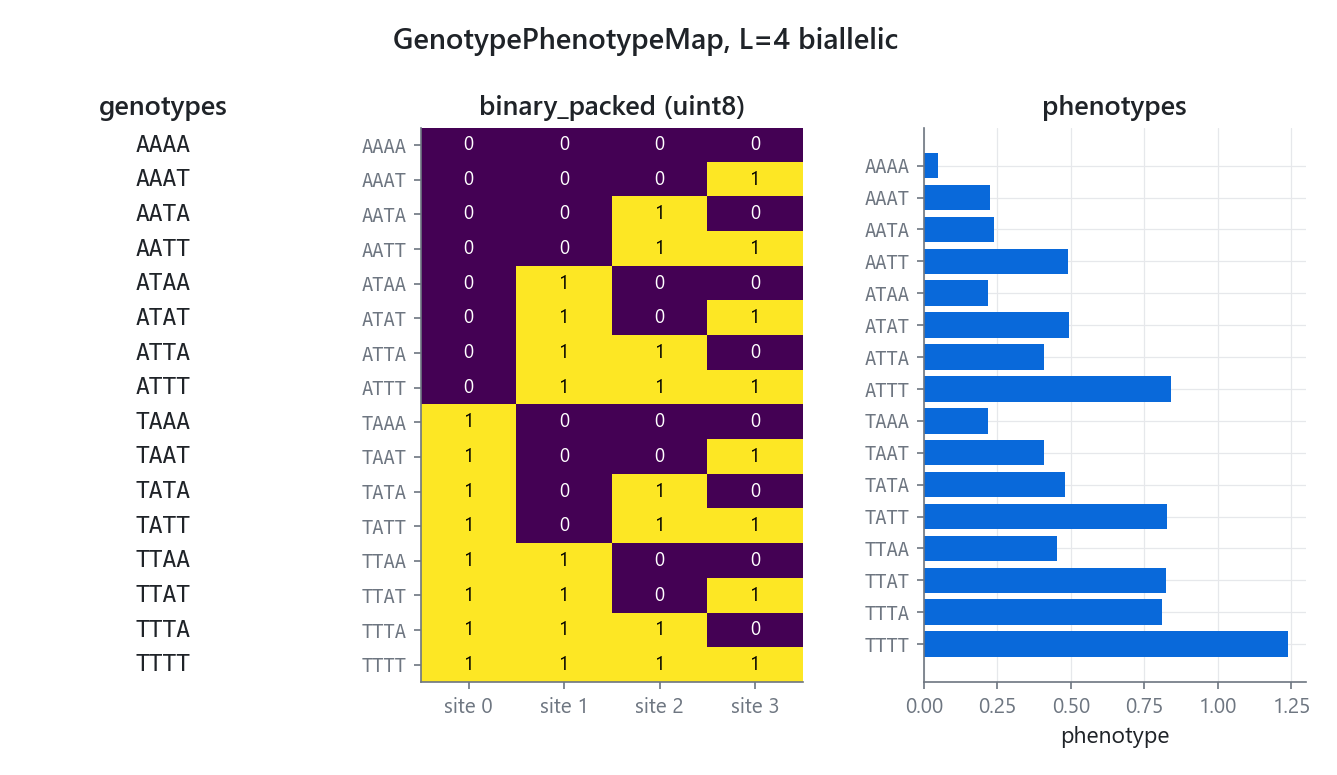
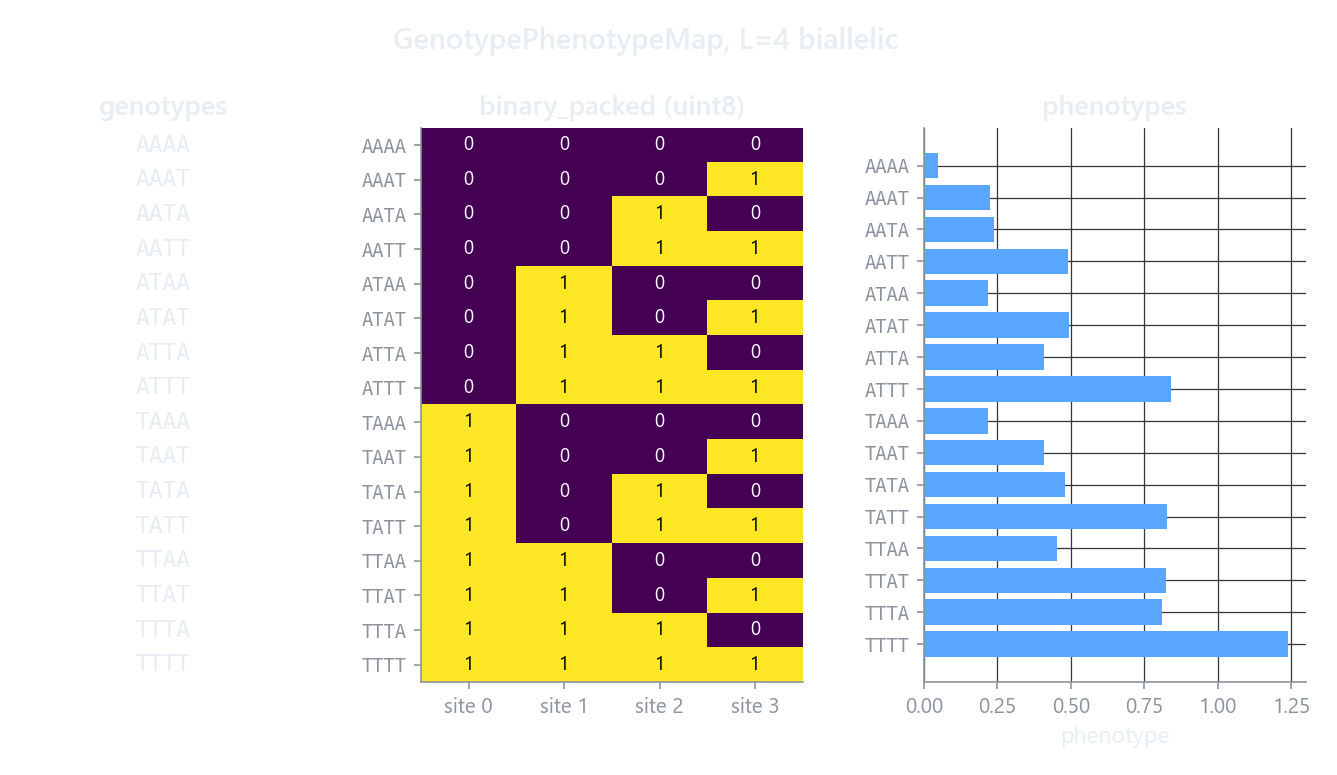
The string-form sibling genotypes_to_binary(...) returns a NumPy object array of '0'/'1' strings. Prefer the packed form for any hot path; the string form is kept for back-compat with v1 consumers.