Missing genotypes
For a partial measurement, you often want the list of genotypes in the full Cartesian product of per-site alphabets that are not in your observed set. gpm.get_missing_genotypes() returns that complement.
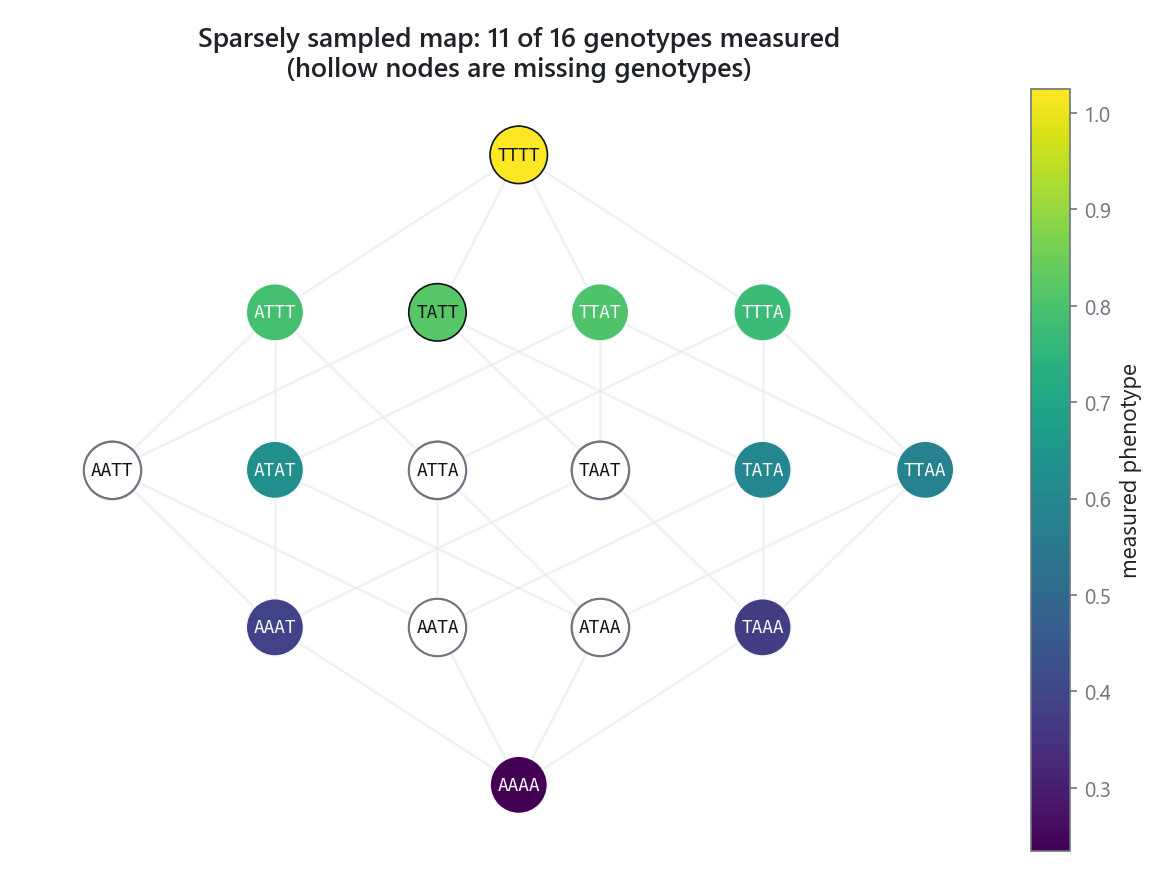
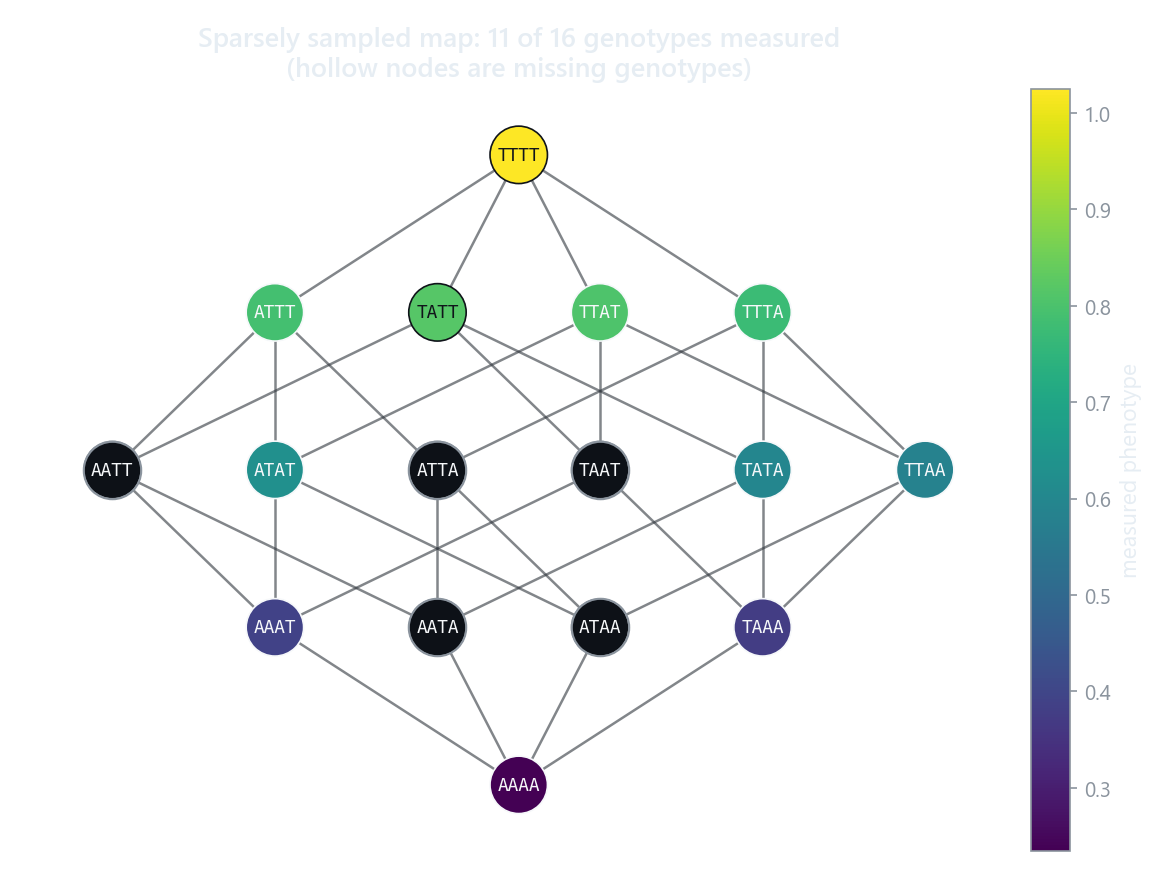
The hollow nodes are the genotypes get_missing_genotypes() returns: present in the full combinatorial space but absent from the measured set.
from gpmap import GenotypePhenotypeMap

gpm = GenotypePhenotypeMap(
    wildtype="AA",
    genotypes=["AA", "AT", "TA"],
    phenotypes=[0.1, 0.2, 0.3],
    mutations={0: ["A", "T"], 1: ["A", "T"]},
)

gpm.get_missing_genotypes()  # array(['TT'], dtype=object)
The method enumerates the full space defined by mutations and removes the observed genotypes. Order matches enumerate_genotypes_str: WT-prefixed alphabetical.
Size-guarded
The full enumeration goes through enumerate_genotypes_str, which respects the 2**28-row safety cap. For a 20-residue amino-acid space (20^20 = 10^26), this raises SpaceTooLargeError:
from gpmap import SpaceTooLargeError

try:
    gpm.get_missing_genotypes()
except SpaceTooLargeError as e:
    print(e)
If you actually do want a huge enumeration, build the full-space genotypes manually with allow_huge=True:
from gpmap import enumerate_genotypes_str

full = enumerate_genotypes_str(
    wildtype=gpm.wildtype,
    mutations=gpm.mutations,
    allow_huge=True,
)
missing = set(full) - set(gpm.genotypes.tolist())
When to use it
The typical use is to write the complement to a CSV so a wet-lab collaborator can target the unobserved genotypes:
import pandas as pd

missing = gpm.get_missing_genotypes()
pd.DataFrame({"genotype": missing}).to_csv("to_measure.csv", index=False)
Or as a sanity check on coverage: