Genotype-phenotype maps
A genotype-phenotype map (GPM) is a table of measured organisms. Each row holds a sequence (the genotype) and one or more measured properties (the phenotype, plus optional standard deviation and replicate count). gpmap-v2 wraps that table in a typed container that adds several derived views: per-site mutation counts, a binary encoding for high-order models, and a pandas DataFrame view for analysis.
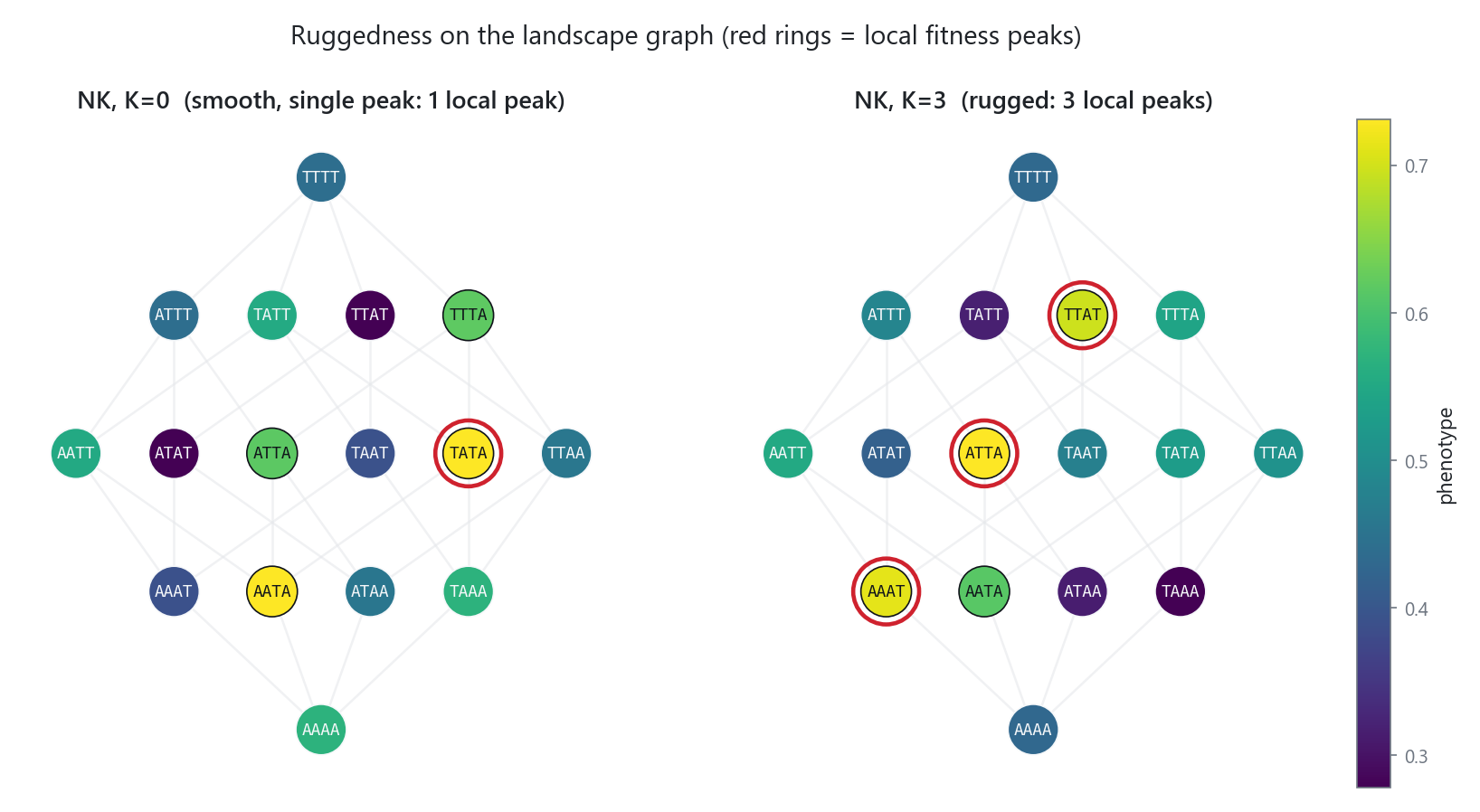
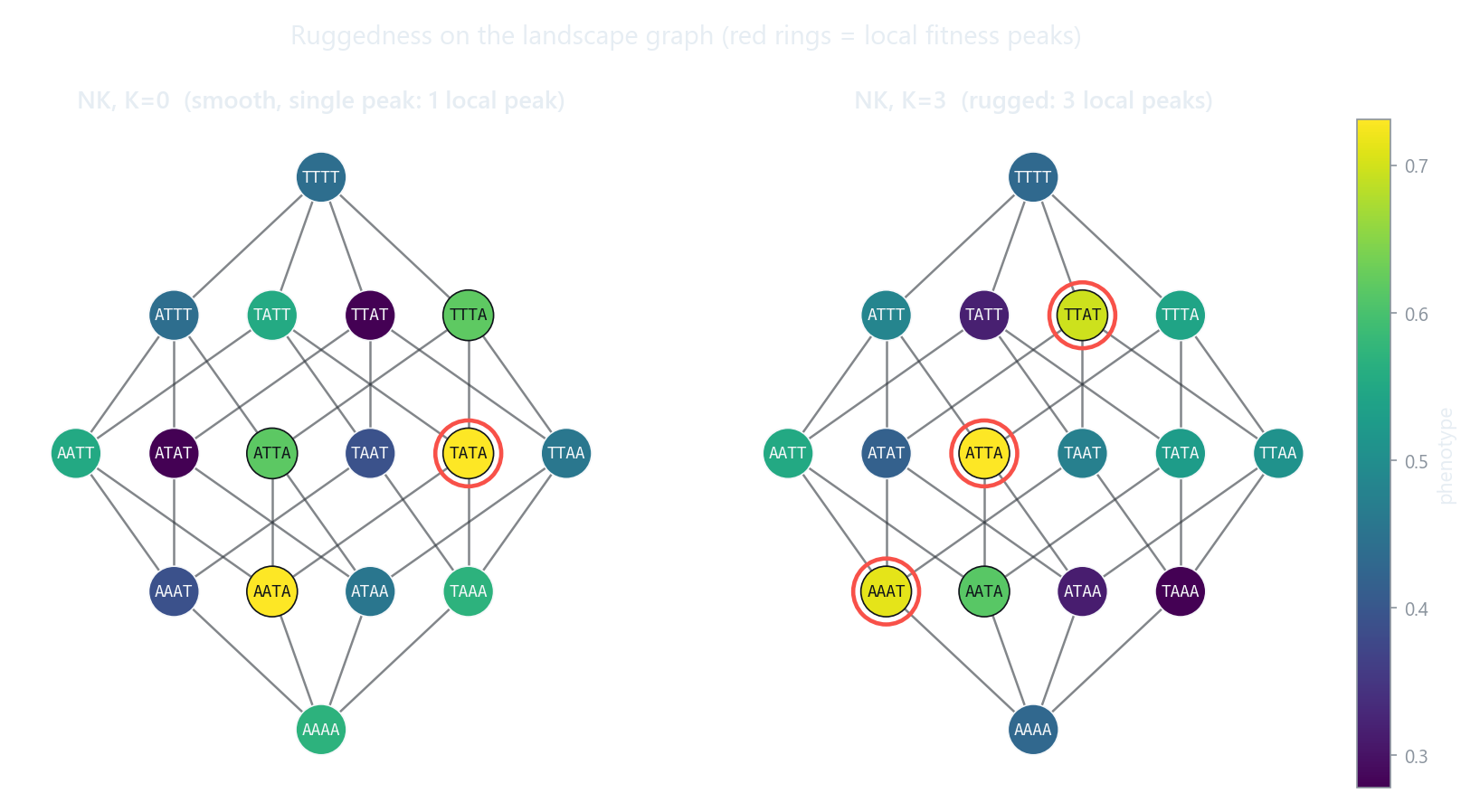
Laying the genotypes out by Hamming distance and coloring by phenotype turns the table into a landscape you can read at a glance: a smooth map slopes toward one peak, a rugged one breaks into many.
The five fields
A GenotypePhenotypeMap is defined by five inputs:
| Field | Type | Meaning |
|---|---|---|
wildtype |
str |
Reference sequence of length L |
genotypes |
list[str] \| np.ndarray |
Observed sequences, each of length L |
phenotypes |
list[float] \| np.ndarray |
Measured phenotypes, one per genotype |
stdeviations |
list[float] \| np.ndarray \| None |
Optional. Defaults to nan |
n_replicates |
list[int] \| np.ndarray \| None |
Optional. Defaults to 1 |
Two derived fields are stored alongside:
| Field | Type | Meaning |
|---|---|---|
mutations |
dict[int, list[str] \| None] |
Per-site alphabets. Defaults to inferring from observed letters |
site_labels |
list[str] |
Per-site labels for plotting. Defaults to ["0", "1", ..., "L-1"] |
Sites and alphabets
A site is a position in the wildtype. A frozen site has alphabet None and only ever holds the wildtype letter. An active site has an explicit alphabet that always includes the wildtype letter:
gpm = GenotypePhenotypeMap(
    wildtype="AXG",
    genotypes=["AXG", "TXG", "AXC"],
    phenotypes=[0.0, 0.5, 0.3],
    mutations={
        0: ["A", "T"],
        1: None,            # frozen
        2: ["G", "C"],
    },
)
When you do not pass mutations, gpmap-v2 infers an alphabet for every site from the union of letters seen in genotypes. Frozen sites are detected by having only the wildtype letter in observed data.
Two views of the same genotype
Every genotype has three equally valid representations inside the container:
- String form (
gpm.genotypes): the human-readable sequence, e.g.,"ATG". - Binary string form (
gpm.binary): a'0'/'1'string under the unary-minus-one encoding from the encoding table. - Packed binary form (
gpm.binary_packed): the same encoding as auint82D NumPy array.
Both binary views are lazy: they are computed the first time you ask, then cached. Downstream packages should prefer binary_packed because it is the closest thing to bytes-on-the-wire and feeds directly into Rust kernels.
gpm.genotypes      # array(['AAA', 'AAT', ...], dtype=object)
gpm.binary         # array(['00', '01', '10', '11'], dtype=object)
gpm.binary_packed  # array([[0, 0], [0, 1], [1, 0], [1, 1]], dtype=uint8)
The pandas view
gpm.data builds a DataFrame combining all of the above, suitable for analysis and notebook display:
| Column | dtype |
|---|---|
genotypes |
string |
phenotypes |
float64 |
stdeviations |
float64 |
n_replicates |
Int64 |
binary |
string |
n_mutations |
Int64 |
It is derived state. Mutating the DataFrame does not mutate the container. To round-trip a modified DataFrame back into a GenotypePhenotypeMap, use GenotypePhenotypeMap.from_dataframe(df, wildtype=...).
Invariants
The container guarantees, on every successful construction:
len(wildtype) == Land every genotype has length L.- Every letter in every genotype is in the per-site alphabet, or equals wildtype on frozen sites.
phenotypes,stdeviations, andn_replicatesare all length n.encoding_tablehas exactly the right number of rows for the alphabet sizes.binary_packed[i, :].sum()equals the Hamming distance (in the unary-minus-one sense) from genotype i to wildtype.- Round-trip:
from_dataframe(gpm.data).data.equals(gpm.data)isTruefor every map.
These six invariants are enforced by contract tests in tests/schema/ on every release.
What is not in the container
gpmap-v2 deliberately does not own:
- Models. Linear, nonlinear, classifier, and Bayesian fits live in
epistasis-v2. - Graphs. The NetworkX wrapping for evolutionary-path analysis lives in
gpgraph-v2. - Plotting.
gpmap-v2ships no plotting code; the streamlit demo uses plotly directly.
This is intentional: the container is the load-bearing dependency, kept small.
Next
- Encoding table for the contract that downstream consumers rely on.
- Schema contract for the load-bearing surface as of
SCHEMA.md.