Markov chains on fitness landscapes
A short primer on what gpvolve-v2 is actually computing and why the choices matter.
The discrete-time chain
gpvolve-v2 models evolution on a genotype-phenotype map as a discrete-time
Markov chain on the genotype graph. The state space is the set of genotypes
in the map (one per row of gpm.data); the transition matrix P is
row-stochastic and supported on the graph's edges plus the diagonal.
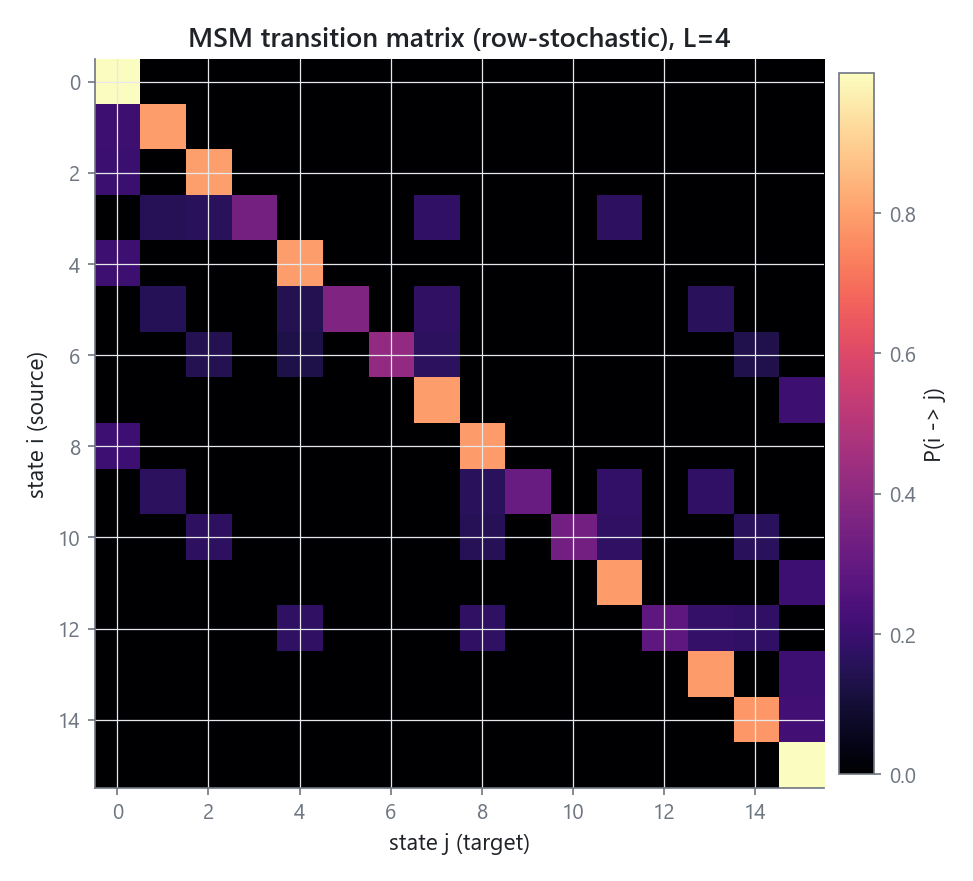
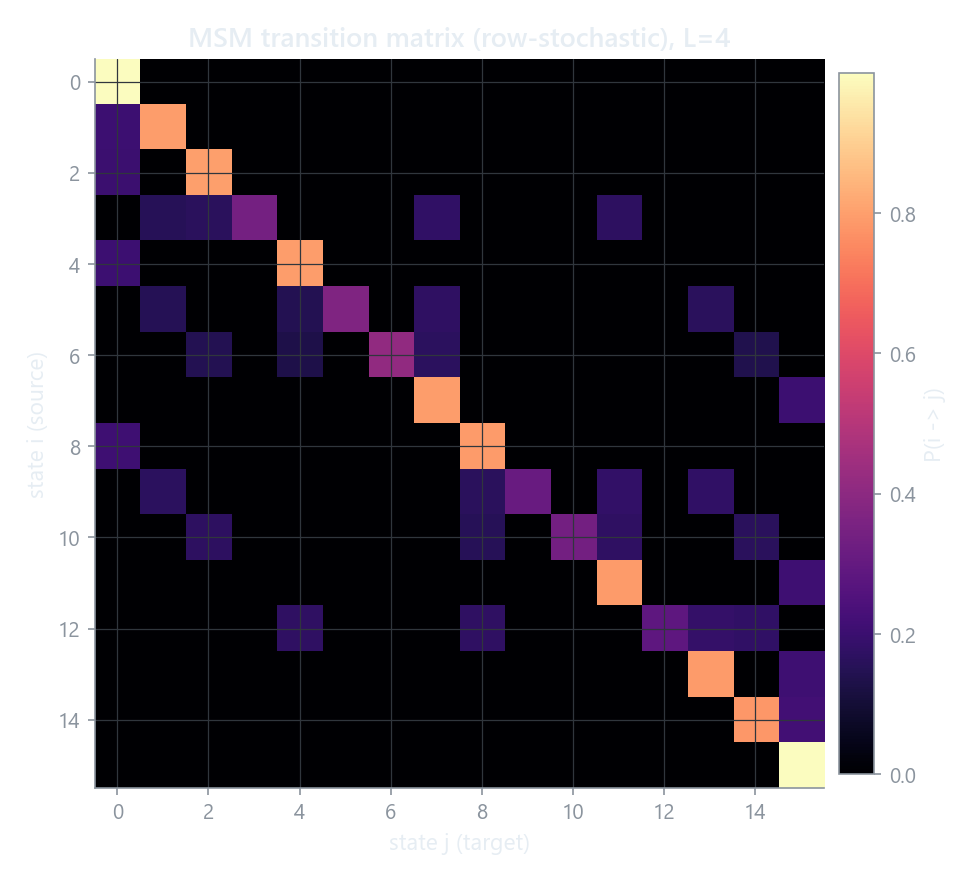
Each row of P sums to one. Most mass sits on the diagonal (self-loops absorb
the probability not assigned to uphill moves), with off-diagonal entries only
where the graph has an edge.
Each off-diagonal entry has the form
where \(\pi_{\text{fix}}\) is the fixation probability for a mutation from genotype \(i\) to a neighbor \(j\), evaluated at fitnesses \(f_i\) and \(f_j\), and \(k_{\max}\) is the maximum out-degree of any node. The normalization by \(k_{\max}\) is the discrete-time convention of Sailer and Harms (2017): in each time step the population attempts one mutation at one of \(k_{\max}\) neighbor sites with equal probability, then accepts or rejects according to the fixation kernel. The diagonal entry is the residual:
so the chain is row-stochastic by construction. gpvolve-v2 asserts this to
1e-12 after building the matrix and raises NonStochasticError if a
bounded fixation kernel ever returns a value outside [0, 1]. See
SCHEMA section 2
for the full contract.
Strong-selection weak-mutation
The "discrete time step" here is one mutation-and-fixation attempt, not a generation. The model assumes the strong-selection weak-mutation regime where adaptive substitutions are well-separated in time: at most one mutation segregates in the population at a time, and selection on between-allele competition is much faster than the mutation rate. Under that regime, the population is monomorphic between fixation events and the chain on genotypes is a faithful summary of the underlying Wright-Fisher process.
When selection is weak relative to drift, or when many mutations segregate
simultaneously, the SSWM picture breaks down. For those regimes use
simulate.wright_fisher (discrete generations with multinomial sampling)
or simulate.gillespie (exact event times with arbitrary fixation kernels)
instead of the MSM machinery.
Reversibility
The chain is reversible only when the fixation kernel and the fitness
landscape together satisfy detailed balance. SSWM, Moran, and McCandlish on
log-additive landscapes give reversible chains; the same kernels on
landscapes with epistasis generally do not. The backward committor solver
(backward_committor) constructs the time-reversed chain explicitly so
TPT works in both cases. For PCCA+ clustering we use the right
eigenvectors of P directly rather than the symmetric similarity transform,
so non-reversible chains do not need a special path.
When the matrix is large
For maps with 2^L states, P has order L * 2^L non-zeros. Up to about
2^16 states everything fits in memory comfortably. Above that, the
bottleneck is typically the dense spectral analysis used for pcca_plus,
which scales as the cube of the state count. The MSM container does not
eagerly compute eigenvectors; only the analyses that need them pay the cost.
When to trust the numbers
Two failure modes to watch for:
- The graph is not strongly connected. Then the stationary
distribution is not unique and committors may be ill-defined on
the disconnected components. Check with
gpvolve.markov.is_strongly_connected. - The fixation kernel underflows to zero. With population sizes in the thousands and large fitness gaps, Moran and McCandlish can return values smaller than 1e-300. gpvolve-v2 keeps these entries in the sparsity pattern with very small but non-zero weights so path-finding still traverses them; spectral analysis and committor solves should still be stable, but the resulting timescales become astronomical.
Where to read more
- McCandlish (2011) for the fixation kernel.
- Sailer and Harms (2017) for the discrete-time normalization convention.
- Berezhkovskii, Hummer, Szabo (2009) for the TPT formulation we implement.
- Roeblitz and Weber (2013) for PCCA+.
- Sokal (1989) for the integrated autocorrelation time used by
ConvergenceCheck.