Transition path theory
TPT gives a probability-flux decomposition of an MSM between two state sets
A (source) and B (target). gpvolve-v2 implements the Berezhkovskii,
Hummer, Szabo (2009) formulation. No msmtools dependency.
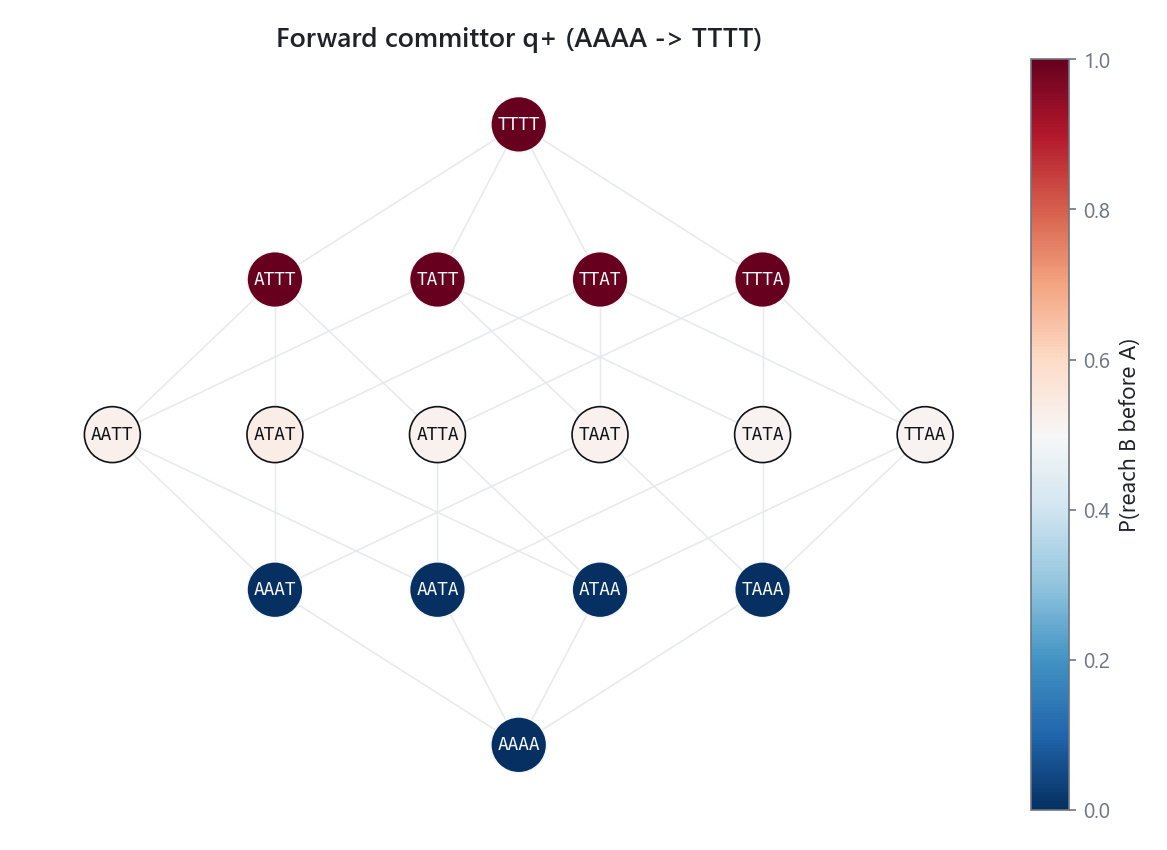
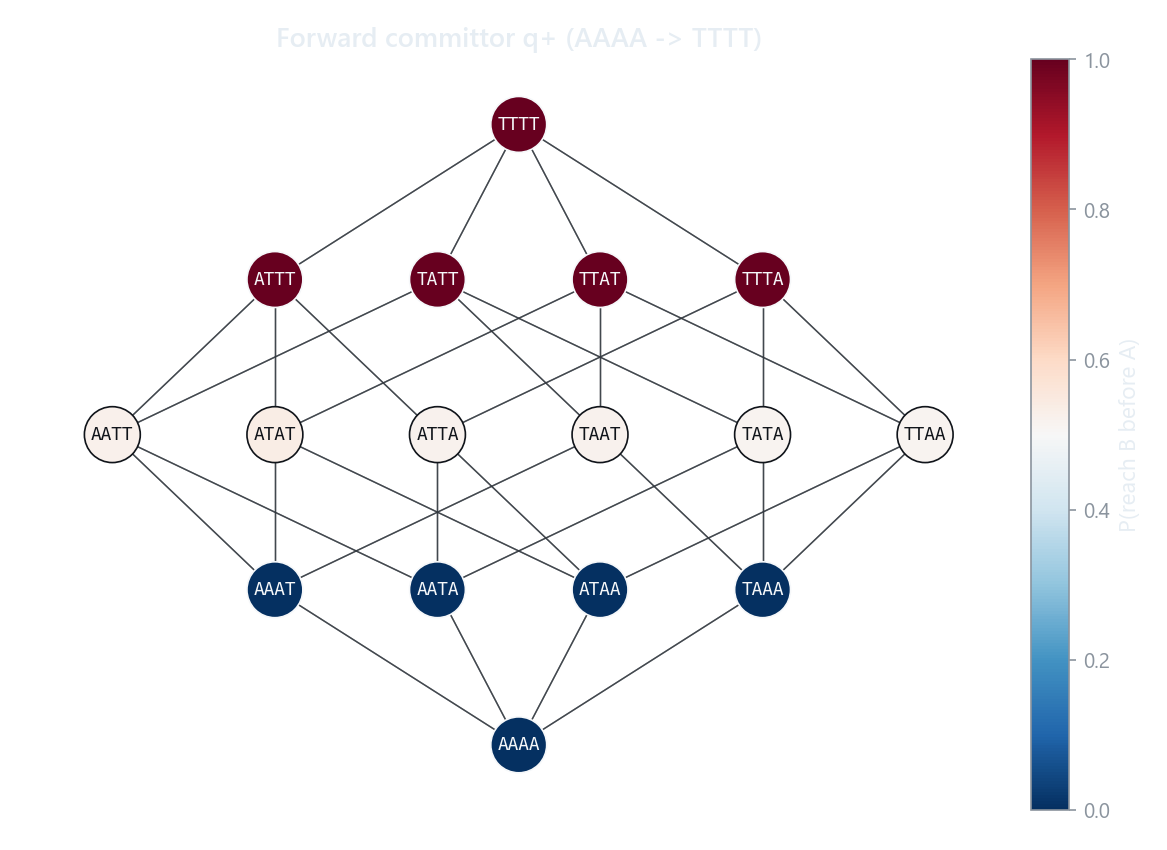
The forward committor colors each genotype by its probability of reaching the
target peak before returning to the source: a smooth gradient from 0 at A to
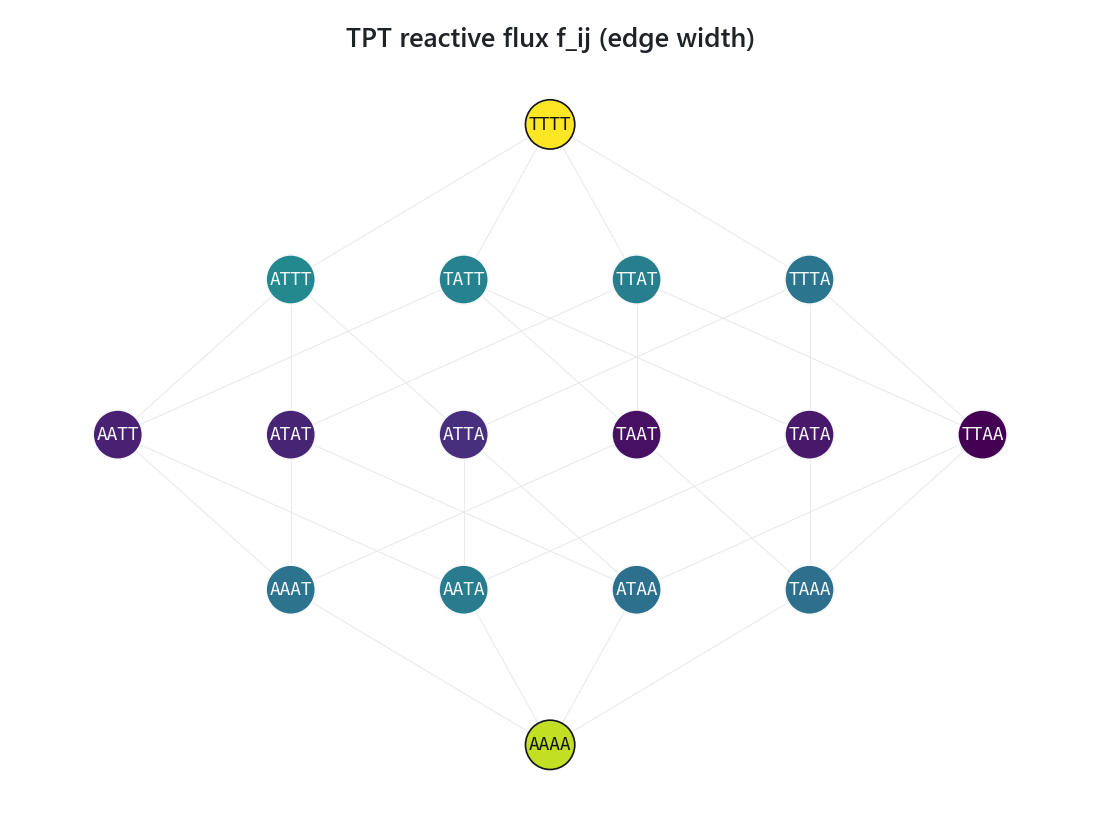
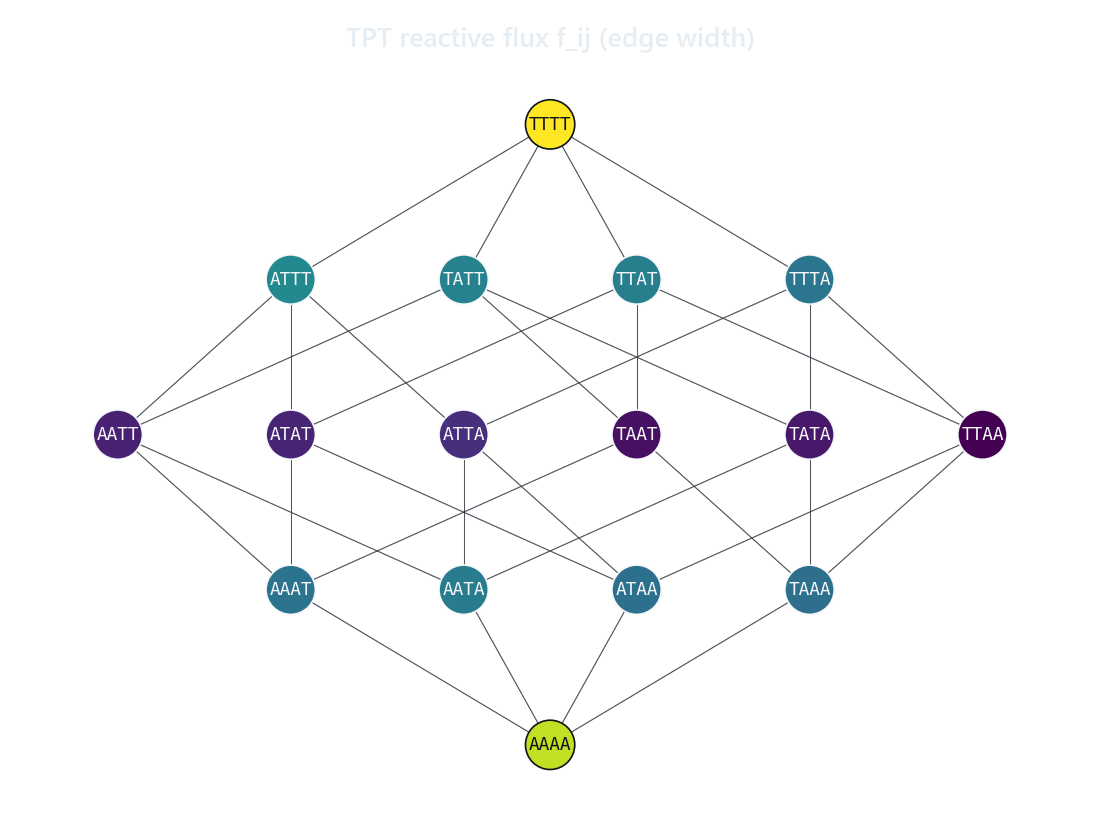
1 at B. The reactive flux then shows where the probability current actually
flows between them.
The four quantities
Forward committor. \(q^{+}_{i} = \mathbb{P}(\text{chain reaches } B \text{ before } A \mid X_0 = i)\). Solved as a linear system with boundary conditions \(q^{+}_{A} = 0\) and \(q^{+}_{B} = 1\):
where \(P_{\text{off}}\) is \(P\) with rows in \(A\) and \(B\) zeroed.
Backward committor. \(q^{-}_{i} = \mathbb{P}(\text{chain came from } A \text{ before } B \mid X_0 = i)\). Equal to \(1 - q^{+}_{i}\) only for reversible chains. For non-reversible chains gpvolve-v2 builds the time-reversed transition matrix explicitly and runs the forward solver with swapped boundary sets.
Reactive flux.
Nonnegative and supported on the off-diagonal of the graph.
Rate.
API
from gpvolve import forward_committor, backward_committor, reactive_flux, rate

q_plus  = forward_committor(P, A=source, B=target)
q_minus = backward_committor(P, A=source, B=target)
F       = reactive_flux(P, A=source, B=target)
k       = rate(P, A=source, B=target)
All four accept either a single state or an iterable of states for both
A and B. They must be disjoint.
Dominant pathways
dominant_pathways(flux, A, B, top_k=10) returns the top-k bottleneck
pathways through the reactive flux. The decomposition is the standard
Dijkstra-on-(-log(flux)) maximum-bottleneck-path algorithm, repeated with
the bottleneck flux subtracted at each step (the Karp 1980 procedure).
Pathways are returned as PathEnsemble instances sorted by bottleneck flux
descending.