Stochastic path sampling
sample_paths runs Monte Carlo walkers on the MSM until two convergence
criteria for each endpoint are simultaneously satisfied:
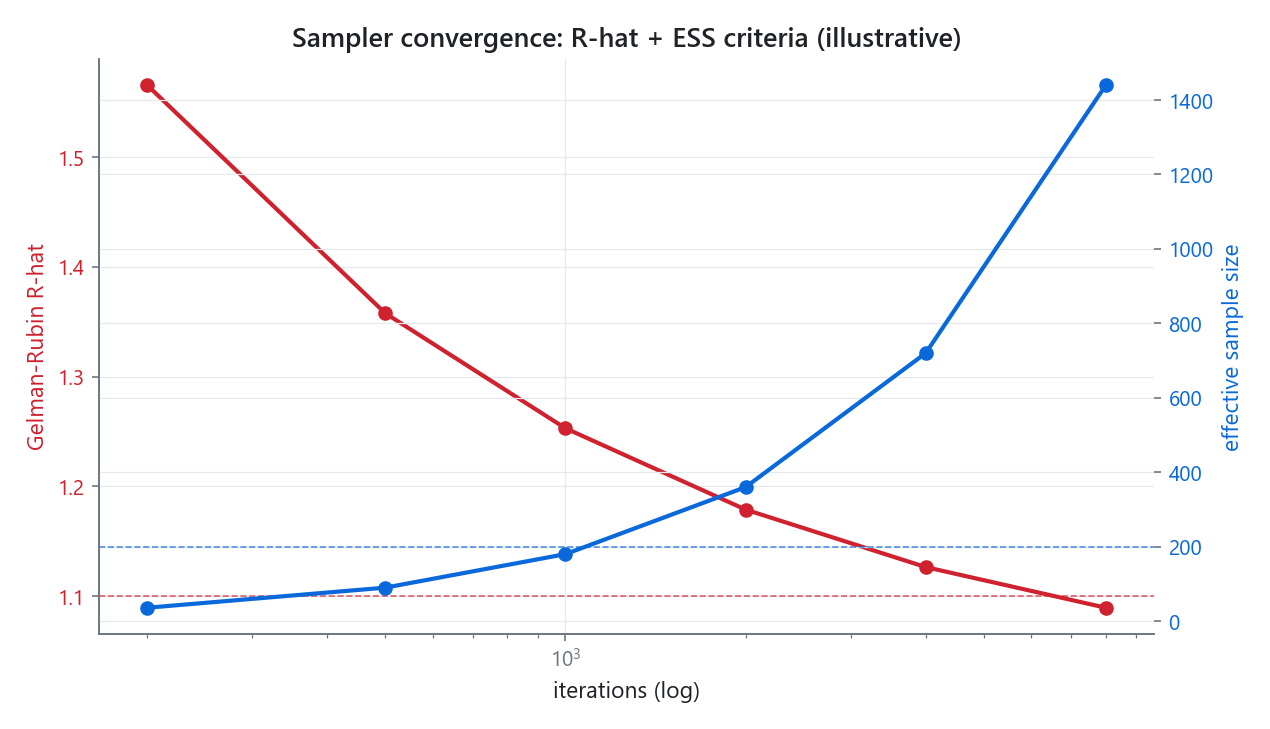
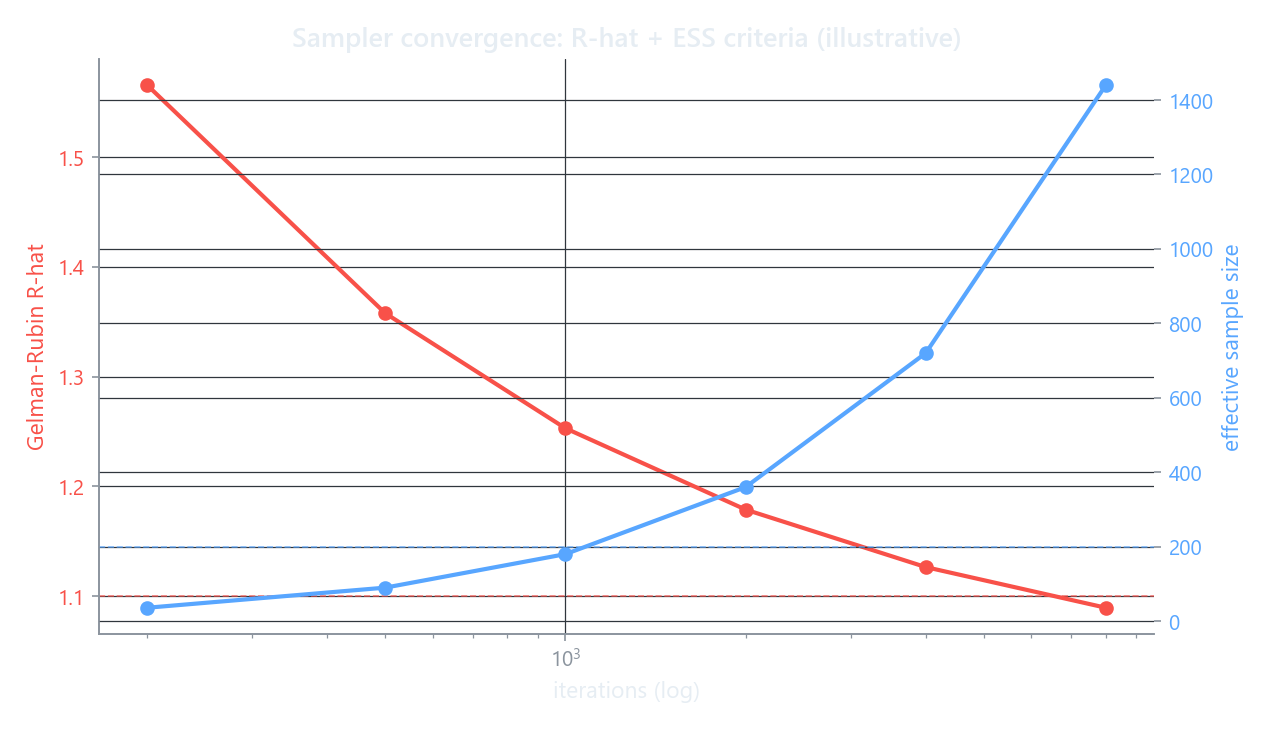
- ESS via Sokal-windowed integrated autocorrelation. For each target
b, the indicator1[walker hit b]is treated as a time series across walker IDs; the integrated autocorrelation timetau_intis estimated with the standard Sokal windowing. The effective sample size isN / (2 * tau_int). Default threshold:ess_min=200. - Gelman-Rubin R-hat across chains. Walkers are split into
m >= 4chains; R-hat is computed on the binary hit indicator. Default threshold:rhat_max=1.01.
Endpoints with empirical hit probability below relevance_threshold (default
1e-3) are excluded from the check, so vanishingly-rare targets do not
hold up convergence.
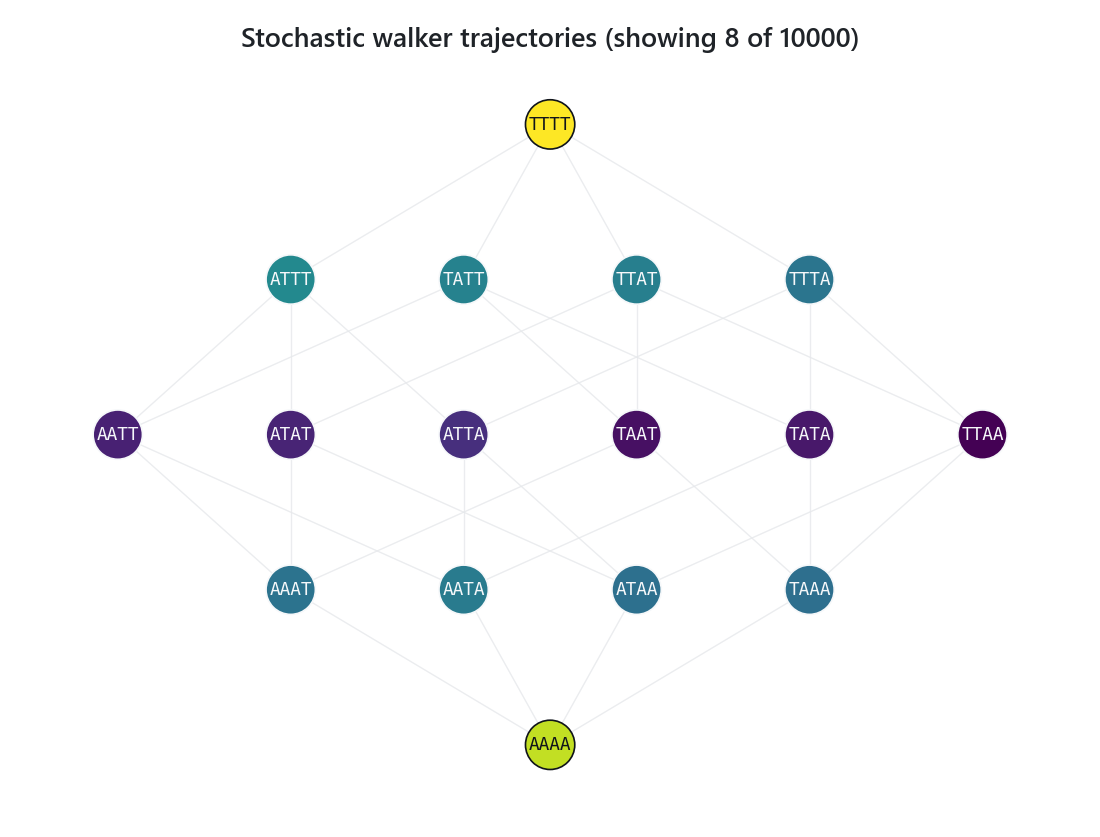
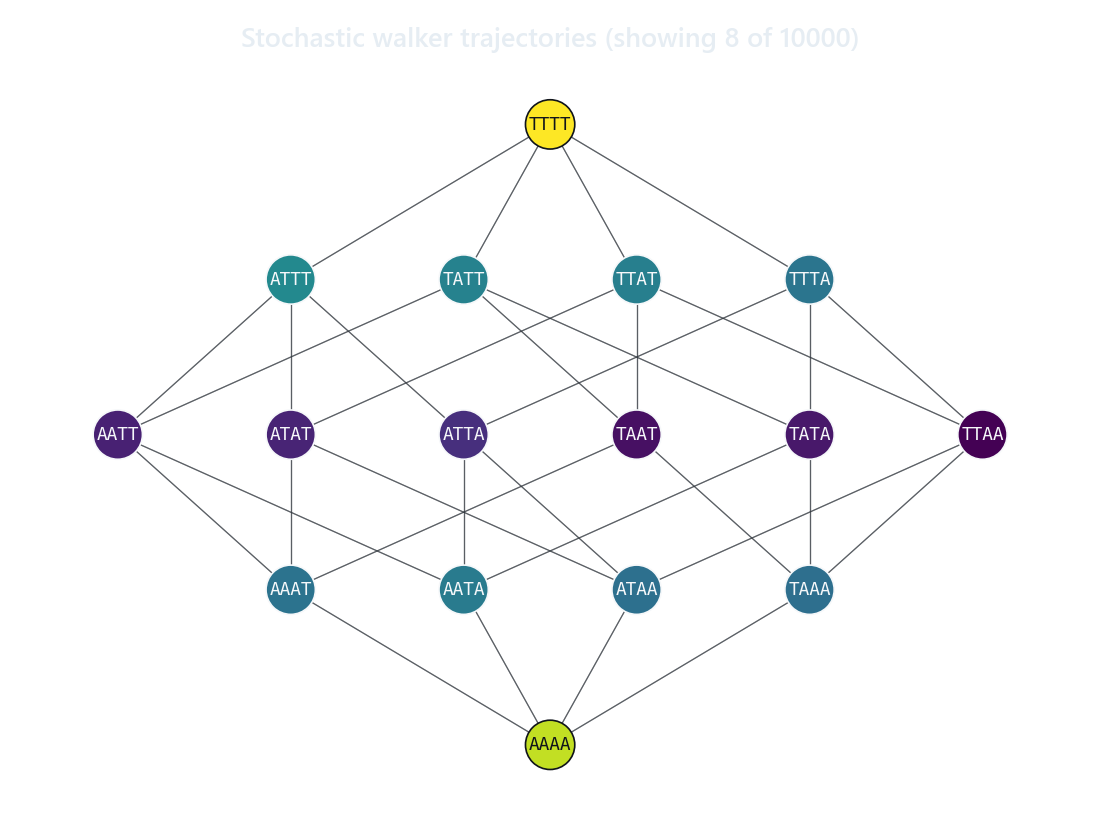
Each walker is one Monte Carlo realization of the evolutionary chain; overlaying many traces shows which routes the ensemble actually takes. Sampling continues until both convergence diagnostics settle:
v1 vs v2
v1 stopped on a Euclidean distance threshold over the empirical path distribution. That criterion has no statistical interpretation: correlated samples push the L2 norm down faster than the marginals actually converge, the distribution is multinomial on a sparse support, and continuing to sample after the marginals stabilize keeps reducing the L2 norm anyway.
v2 replaces it with ESS + R-hat. KL divergence with bootstrap CI is offered
as a separate diagnostic in analysis.observables but is not a stopping
rule (KL is unstable on sparse empirical multinomials with zeros).
API
from gpvolve import ConvergenceCheck, sample_paths

cc = ConvergenceCheck(
    ess_min=200.0,
    rhat_max=1.01,
    relevance_threshold=1e-3,
    chunk_size=10_000,
    max_walkers=1_000_000,
    n_chains=4,
)
ens = sample_paths(msm, source=0, targets=[31, 63], convergence=cc, seed=0)
The returned PathEnsemble has metadata["convergence"] matching SCHEMA
section 6: {ess, rhat, n_walkers, n_chunks, converged}. If the walker
budget is exhausted without convergence, ConvergenceError is raised; the
last-known ess and rhat are in the exception message.
Recommended budgets
- Tiny maps (
n <= 64):chunk_size=200,ess_min=50is usually enough. - 2^10 to 2^14 binary maps: defaults are fine.
- Larger maps with deep metastable traps: increase
max_walkersto5e6and consider running multiple seeds to verify R-hat across independent runs.