PCCA+ and metastable clustering
PCCA+ (Roeblitz and Weber 2013) decomposes an MSM into k metastable
basins. It is the spectral generalization of "find the deep valleys in the
landscape": given the top-k right eigenvectors of the transition matrix,
identify k vertices of a simplex such that the rows of the eigenvector
matrix project onto a row-stochastic membership matrix chi of shape
(n_states, k).
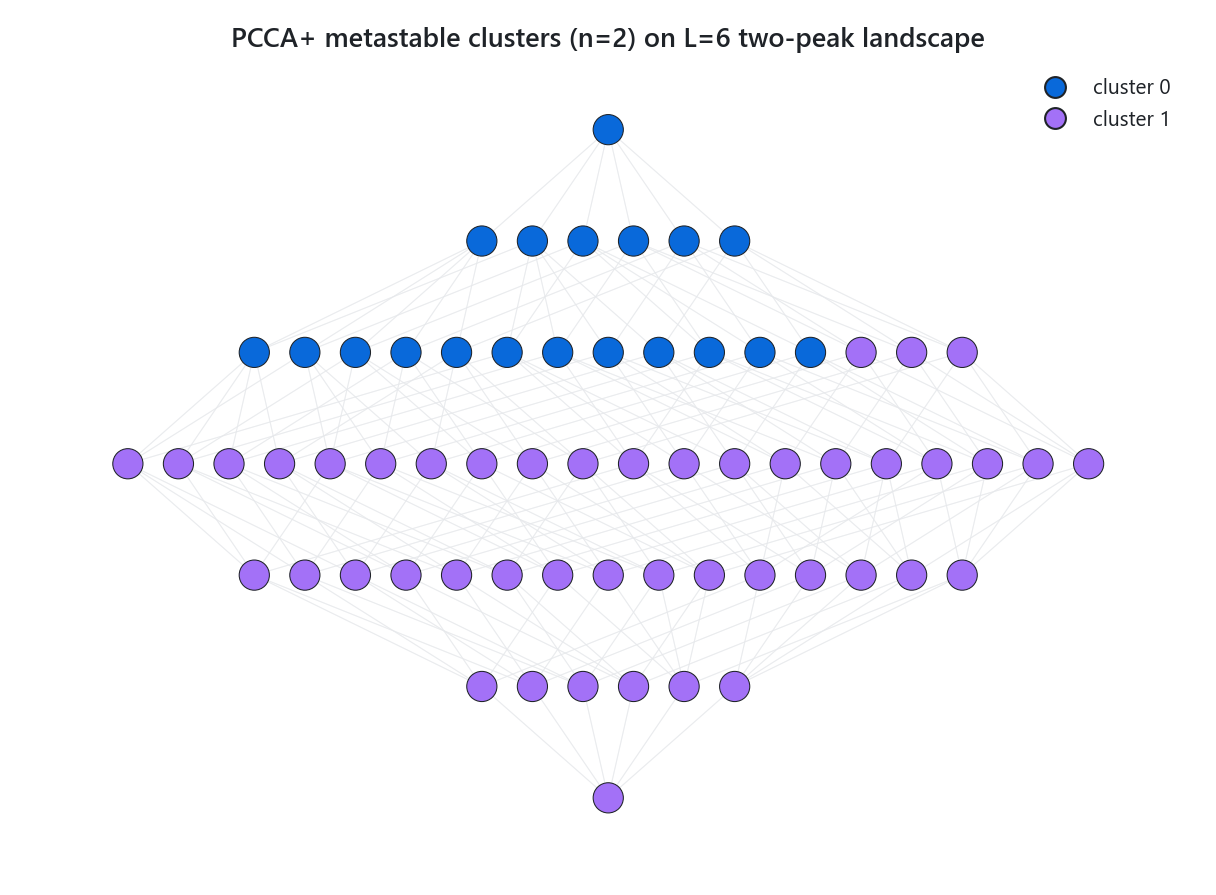
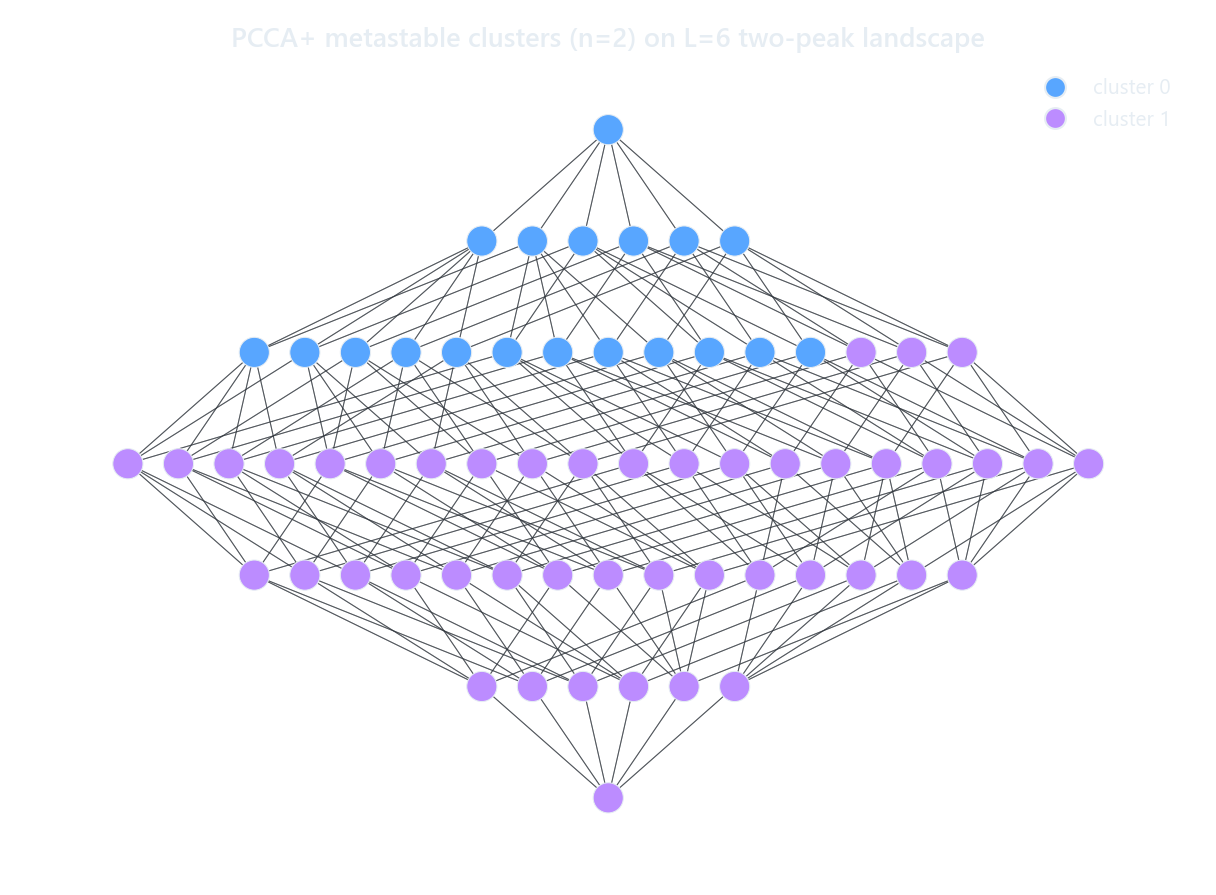
Coloring each genotype by its dominant cluster membership shows the metastable basins PCCA+ recovers: groups of states the chain mixes within quickly but crosses between only rarely.
API
from gpvolve import pcca_plus, metastable_sets, coarse_grain

chi = pcca_plus(msm.transition_matrix, n_clusters=3)
sets = metastable_sets(chi)  # hard argmax assignment per state
P_coarse = coarse_grain(msm.transition_matrix, chi)
chi rows sum to 1.0 within numerical tolerance and entries are
non-negative. metastable_sets returns one int array per cluster; together
they partition the state space.
coarse_grain applies the Galerkin projection
with \(D = \operatorname{diag}(\pi)\), to produce a row-stochastic transition matrix on the metastable basins.
Implementation notes
gpvolve-v2 implements PCCA+ from scratch (no msmtools dependency):
- Compute the top-
kright eigenvectors ofP(dense eig for smalln). - Normalize the leading eigenvector to a constant.
- Inner-simplex algorithm to pick
krepresentative states. - Form the candidate
chimatrix and project onto the row-stochastic simplex. - Light Gauss-Newton refinement of the rotation matrix
A.
The implementation works for non-reversible chains. For reversible chains
the result matches msmtools PCCA+ to within projection-step tolerance.