Cross-validate epistasis models to prevent overfitting
Epistasis models with many free parameters, high interaction order or weak regularization, can fit the training phenotypes closely while predicting unseen genotypes poorly. The epistasis.validate module provides two cross-validation helpers, k_fold and holdout, that let you measure generalization performance and choose the interaction order and regularization strength that work best for your dataset.
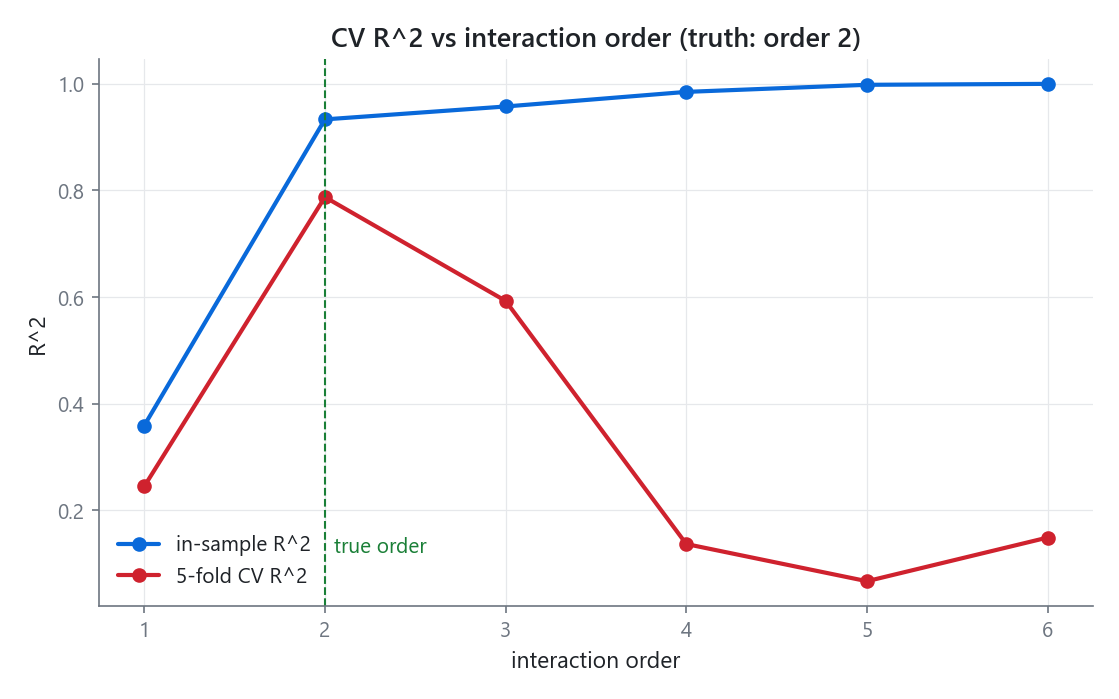
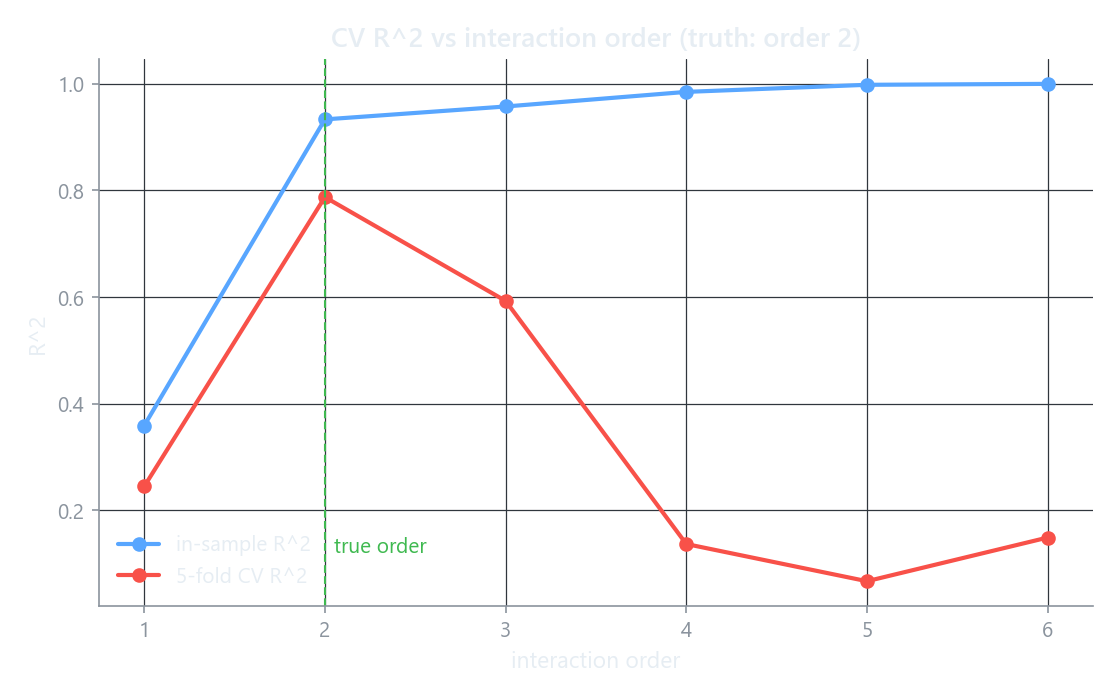
The gap between in-sample and cross-validated R^2 is exactly the overfitting this page helps you avoid: training fit climbs monotonically with order, while held-out fit peaks at the true interaction order and then degrades.
Why validate?
A model's training R^2 always increases as you raise the interaction order, because more parameters fit the observed phenotypes more tightly. Cross-validation exposes whether that improvement represents real signal or memorization: you fit the model on one part of the data and score it on another part the model has never seen. When test R^2 levels off or drops while training R^2 keeps rising, you have found the point of overfitting.
k_fold
k_fold partitions the GPM into k roughly equal folds, trains on k - 1 of them, and scores on the held-out fold. It repeats this for every fold and returns the list of per-fold R^2 values (Pearson r^2).
from epistasis.validate import k_fold
from epistasis.models.linear import EpistasisLinearRegression

scores = k_fold(gpm, model, k=10, rng=None)
Parameters
gpm(GenotypePhenotypeMap, required)- The full genotype-phenotype map to cross-validate. All genotypes are used; no pre-split is needed.
model(EpistasisBaseModel, required)- A freshly constructed (unfitted) epistasis model. Pass a new instance each time you call
k_foldso that no fitted state from a previous run leaks into the evaluation. k(int, default10)- Number of folds. Must be in
[2, n]wherenis the number of genotypes. Smallerk(e.g., 5) gives faster evaluation; largerk(e.g., leave-one-out atk = n) gives lower-bias estimates but is slower. rng(np.random.Generator | None, defaultNone)- A NumPy random generator used to shuffle genotype indices before splitting into folds. Pass a seeded generator for reproducible fold assignments.
k_fold returns a list[float], one R^2 value per fold. Each value is the squared Pearson correlation between the held-out phenotypes and the model's predictions for those genotypes.
Note
R^2 here is Pearson r^2 (correlation-based), not the coefficient of determination 1 - SSR/SST. Values close to 1.0 indicate strong predictive performance on held-out genotypes.
holdout
holdout performs repeated random train/test splits. On each repeat it fits the model on fraction of the genotypes and scores both the training set and the test set. It returns both lists so you can compare train and test R^2 directly.
from epistasis.validate import holdout
from epistasis.models.linear import EpistasisLinearRegression

train_scores, test_scores = holdout(gpm, model, fraction=0.8, repeat=5, rng=None)
Parameters
gpm(GenotypePhenotypeMap, required)- The full genotype-phenotype map.
model(EpistasisBaseModel, required)- A freshly constructed epistasis model.
fraction(float, default0.8)- Proportion of genotypes to include in the training set. Must be strictly between 0 and 1. The remainder forms the test set.
repeat(int, default5)- Number of independent random splits to perform. More repeats reduce variance in the score estimates.
rng(np.random.Generator | None, defaultNone)- A NumPy random generator for reproducible splits.
holdout returns (train_scores, test_scores), each a list[float] of length repeat.
split_gpm
Both k_fold and holdout use split_gpm internally, but you can call it directly when you need manual control over how the data is partitioned.
from epistasis.stats import split_gpm
import numpy as np

# Split by explicit indices
train_gpm, test_gpm = split_gpm(gpm, train_idx=np.array([0, 1, 4, 7]))

# Split by fraction (random)
train_gpm, test_gpm = split_gpm(gpm, fraction=0.8, rng=np.random.default_rng(0))
Parameters
gpm(GenotypePhenotypeMap, required)- The GPM to split.
train_idx(np.ndarray | None, defaultNone)- Integer indices (into
gpm.genotypes) to include in the training set. Exactly one oftrain_idxorfractionmust be supplied. fraction(float | None, defaultNone)- Proportion of genotypes to include in the training set. Exactly one of
train_idxorfractionmust be supplied. rng(np.random.Generator | None, defaultNone)- A NumPy random generator, used only when
fractionis supplied.
split_gpm returns (train_gpm, test_gpm), each a GenotypePhenotypeMap containing the appropriate subset of genotypes, phenotypes, and (if present) standard deviations.
Complete example: choosing interaction order with k-fold CV
The following example runs 5-fold cross-validation across interaction orders 1 through 4, then picks the order with the highest mean test R^2.
import numpy as np
from epistasis.validate import k_fold
from epistasis.models.linear import EpistasisLinearRegression

# Assume `gpm` is your loaded GenotypePhenotypeMap
rng = np.random.default_rng(0)

results = {}
for order in range(1, 5):
    model = EpistasisLinearRegression(order=order, model_type="global")
    fold_scores = k_fold(gpm, model, k=5, rng=np.random.default_rng(0))
    mean_r2 = float(np.mean(fold_scores))
    std_r2 = float(np.std(fold_scores))
    results[order] = (mean_r2, std_r2)
    print(f"Order {order}: mean R^2 = {mean_r2:.3f} +/- {std_r2:.3f}")

best_order = max(results, key=lambda o: results[o][0])
print(f"\nBest order by CV: {best_order}")
Warning
Pass a fresh model instance to each k_fold call. Reusing the same fitted model object will cause the fold evaluation to start from a previously fitted state, which can silently inflate your scores.
Tip
Look for test R^2 that flattens or drops as you increase order. That is the signature of overfitting. A small gap between train R^2 (from holdout) and test R^2 is normal; a large gap at the same order is a sign to apply regularization with EpistasisLasso or EpistasisRidge instead.
Comparing train and test R^2 with holdout
To visualize the train-test gap across orders, combine holdout with a simple mean summary:
import numpy as np
from epistasis.validate import holdout
from epistasis.models.linear import EpistasisLinearRegression

for order in range(1, 5):
    model = EpistasisLinearRegression(order=order, model_type="global")
    train_scores, test_scores = holdout(gpm, model, fraction=0.8, repeat=10, rng=np.random.default_rng(1))
    print(
        f"Order {order}: "
        f"train R^2 = {np.mean(train_scores):.3f}, "
        f"test R^2  = {np.mean(test_scores):.3f}"
    )
When the train R^2 is high and the test R^2 is considerably lower, the model is memorizing training phenotypes rather than learning transferable epistatic structure.