Ridge, Lasso, and ElasticNet models
When you fit a high-order epistasis model, the number of interaction terms grows combinatorially with sequence length. Without regularization, the model can overfit the data, capturing noise rather than genuine epistatic signal. The three regularized models in epistasis.models.linear address this by adding a penalty to the loss function that shrinks coefficients toward zero. All three share the same add_gpm -> fit -> predict -> score workflow as EpistasisLinearRegression, with no changes to how you attach data or read results.
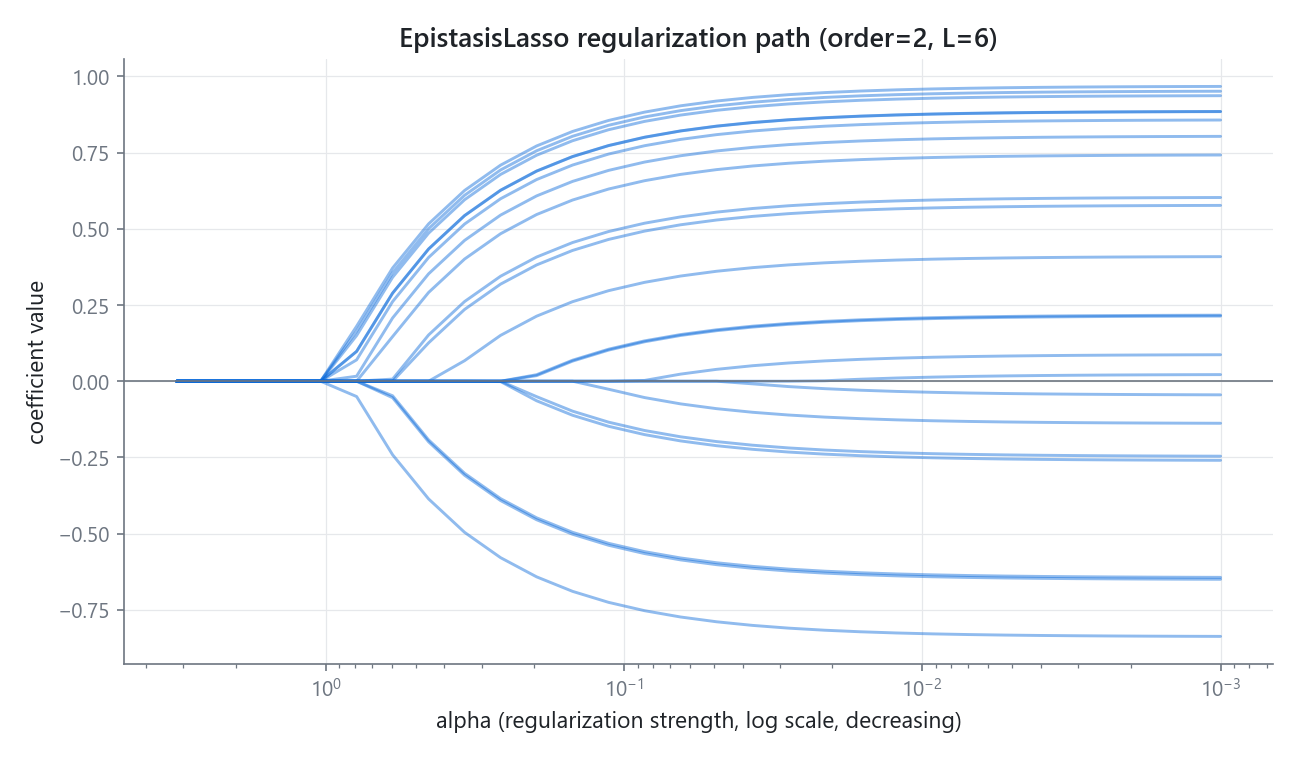
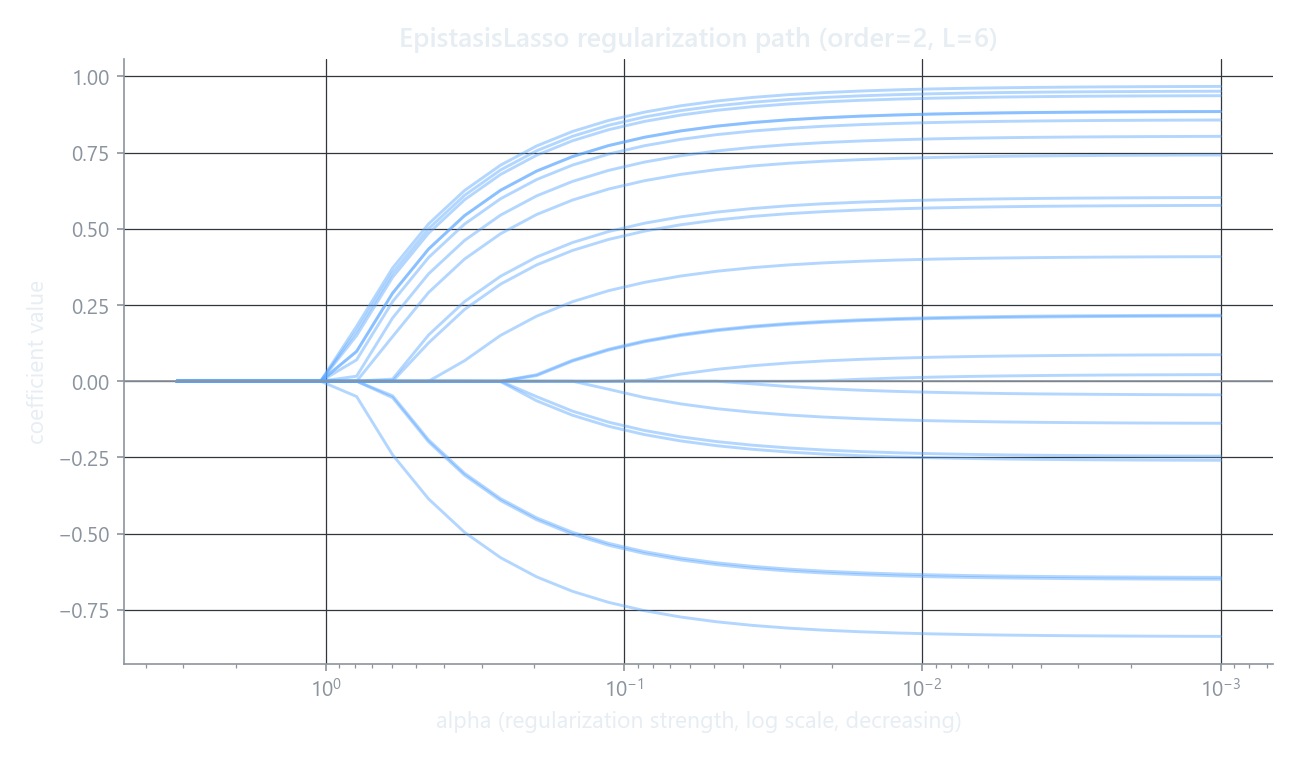
As the Lasso penalty alpha increases (left to right), coefficients are driven to exactly zero one by one, so the path doubles as a feature-selection view over the epistasis design matrix.
Tip
Choose your regularizer based on what you expect about the underlying biology. If you expect most interactions to be small but non-zero, use Ridge. If you expect most high-order interactions to be absent (a sparse landscape), use Lasso. If you are unsure, ElasticNet gives you a tunable blend of both behaviors.
Choosing alpha
All three models expose an alpha parameter that controls regularization strength. Larger values of alpha apply stronger shrinkage, producing simpler models with smaller (or exactly zero) coefficients. Smaller values approach the unregularized OLS solution.
Note
The right value of alpha depends on your data. Use k-fold cross-validation via epistasis.validate.k_fold to select alpha empirically rather than guessing.
EpistasisRidge
EpistasisRidge applies an L2 penalty: it minimizes the residual sum of squares plus \(\alpha \, \sum_k \beta_k^{2}\). L2 regularization shrinks all coefficients smoothly toward zero but rarely drives any coefficient to exactly zero. It is a good default when you believe most interactions are real but small.
Constructor parameters
order(int, default1)- Maximum interaction order to fit.
model_type(str, default"global")- Design-matrix encoding:
"global"(Hadamard) or"local"(biochemical). alpha(float, default1.0)- L2 penalty strength. Setting
alpha=0recovers OLS; preferEpistasisLinearRegressionin that case. max_iter(int | None, defaultNone)- Maximum iterations for iterative solvers.
Nonelets sklearn choose a default based on the solver. tol(float, default1e-4)- Convergence tolerance.
solver(str, default"auto")- sklearn Ridge solver. One of
"auto","svd","cholesky","lsqr","sparse_cg","sag","saga", or"lbfgs"."auto"picks a solver based on the data type and size. random_state(int | None, defaultNone)- Random seed for solvers that use randomness (
"sag","saga").
Ridge example
from epistasis.models.linear import EpistasisRidge

model = EpistasisRidge(order=3, alpha=0.1)
model.add_gpm(gpm)
model.fit()

y_pred = model.predict()
r2 = model.score()
print(f"Ridge R^2: {r2:.4f}")
print("Coefficients:", model.epistasis.values)
EpistasisLasso
EpistasisLasso applies an L1 penalty: it minimizes the residual sum of squares plus \(\alpha \, \sum_k |\beta_k|\). Unlike L2, the L1 penalty drives many coefficients to exactly zero, producing a sparse set of epistatic interactions. After fitting, call model.compression_ratio() to see what fraction of coefficients were zeroed out.
Constructor parameters
order(int, default1)- Maximum interaction order to fit.
model_type(str, default"global")- Design-matrix encoding:
"global"or"local". alpha(float, default1.0)- L1 penalty strength. Setting
alpha=0is OLS and triggers a sklearn warning; preferEpistasisLinearRegressionfor the unregularized case. max_iter(int, default1000)- Maximum coordinate-descent iterations. Increase if the solver reports a convergence warning.
tol(float, default1e-4)- Convergence tolerance on the dual gap.
warm_start(bool, defaultFalse)- When
True, reuse the previous solution as the starting point on repeated calls tofit. Useful when scanning a path ofalphavalues. positive(bool, defaultFalse)- Force all fitted coefficients to be non-negative.
selection(str, default"cyclic")- Coordinate update strategy:
"cyclic"or"random". Random selection often converges faster whentolis loose. random_state(int | None, defaultNone)- Seed used when
selection="random". precompute(bool, defaultFalse)- Whether to use a precomputed Gram matrix to speed up coordinate descent for dense problems.
Lasso example
from epistasis.models.linear import EpistasisLasso

model = EpistasisLasso(order=4, alpha=0.05)
model.add_gpm(gpm)
model.fit()

y_pred = model.predict()
print(f"Compression ratio: {model.compression_ratio():.1%}")  # fraction zeroed
print("Non-zero coefficients:", model.epistasis.values[model.epistasis.values != 0])
EpistasisElasticNet
EpistasisElasticNet blends L1 and L2 regularization. The l1_ratio parameter sets the balance: l1_ratio=1.0 is pure Lasso, l1_ratio=0.0 is pure Ridge, and values in between give a mix of sparsity-inducing and coefficient-shrinking behavior.
Warning
A bug in epistasis-v1 silently overwrote l1_ratio to 1.0 during __init__, making the model behave as pure Lasso regardless of user input. This is fixed in v2. If you are migrating from v1, re-check any ElasticNet fits that relied on l1_ratio < 1.0.
Constructor parameters
order(int, default1)- Maximum interaction order to fit.
model_type(str, default"global")- Design-matrix encoding:
"global"or"local". alpha(float, default1.0)- Combined penalty strength applied to the L1 + L2 blend.
l1_ratio(float, default0.5)- Fraction of the penalty that is L1. Must be in
[0, 1]. Values outside this range raise aValueError. max_iter(int, default1000)- Maximum coordinate-descent iterations.
tol(float, default1e-4)- Convergence tolerance on the dual gap.
warm_start(bool, defaultFalse)- Reuse the previous solution on repeated
fitcalls. positive(bool, defaultFalse)- Force all fitted coefficients to be non-negative.
selection(str, default"cyclic")- Coordinate update strategy:
"cyclic"or"random". random_state(int | None, defaultNone)- Seed for
selection="random". precompute(bool, defaultFalse)- Use a precomputed Gram matrix.
ElasticNet example
from epistasis.models.linear import EpistasisElasticNet

# 70% L1, 30% L2 mix.
model = EpistasisElasticNet(order=3, alpha=0.1, l1_ratio=0.7)
model.add_gpm(gpm)
model.fit()

y_pred = model.predict()
r2 = model.score()
print(f"ElasticNet R^2: {r2:.4f}")
print(f"Compression ratio: {model.compression_ratio():.1%}")
Shared methods
All three regularized models inherit from RegularizedLinearBase and expose the same interface:
| Method | Description |
|---|---|
fit(X=None, y=None) |
Fit the model. Returns self. |
predict(X=None) |
Predict phenotypes; returns a 1D np.ndarray. |
score(X=None, y=None) |
Return R^2 between predicted and observed phenotypes. |
hypothesis(X=None, thetas=None) |
Evaluate X @ thetas without modifying stored state. |
compression_ratio() |
Fraction of fitted coefficients that are exactly zero. Most meaningful for Lasso and ElasticNet. |
The coef_ property mirrors thetas for sklearn API parity. epistasis.values is populated after every fit call.
Note
Regularized models do not compute analytic standard errors. model.epistasis.stdeviations is not set by fit. If you need uncertainty estimates for regularized coefficients, use bootstrap resampling or Bayesian methods.