Walsh-Hadamard fast path reference
The epistasis.fast module exposes fwht_ols_coefficients, a closed-form OLS solver for full-order biallelic libraries encoded under the global (Hadamard) scheme. Instead of constructing the n x n design matrix and calling a dense least-squares solver, it exploits the Hadamard structure to solve for all 2^L coefficients in O(n log n) operations.
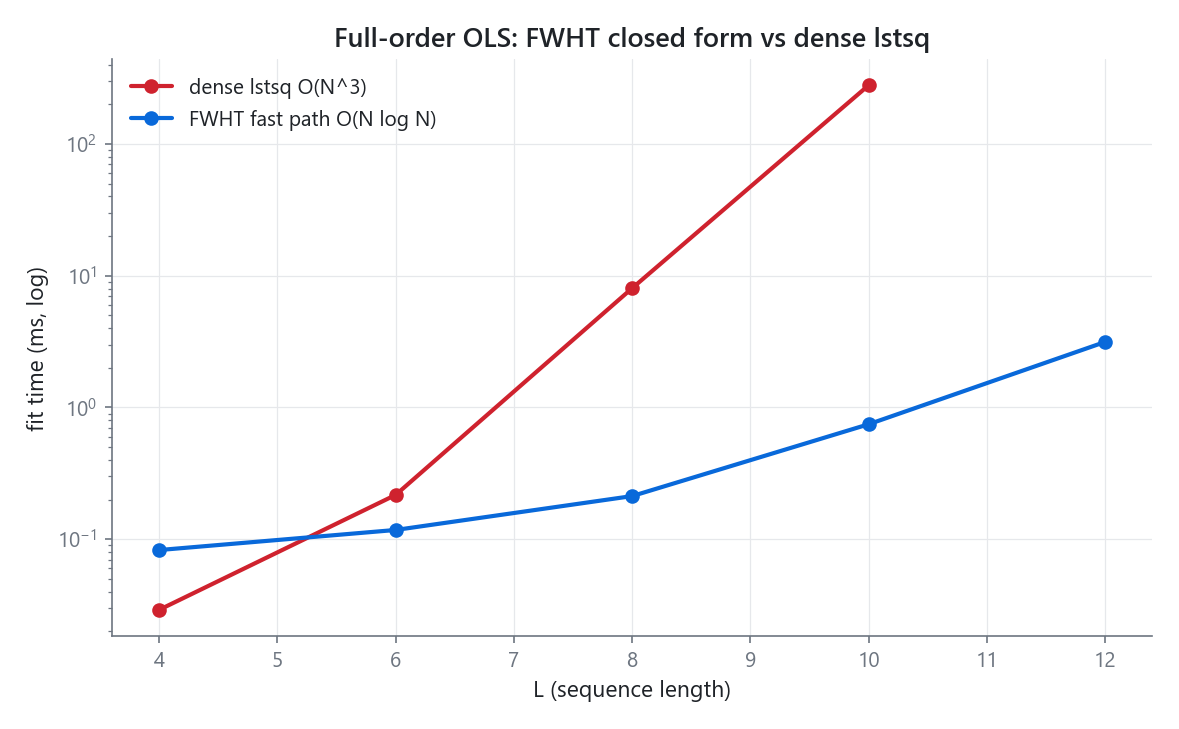
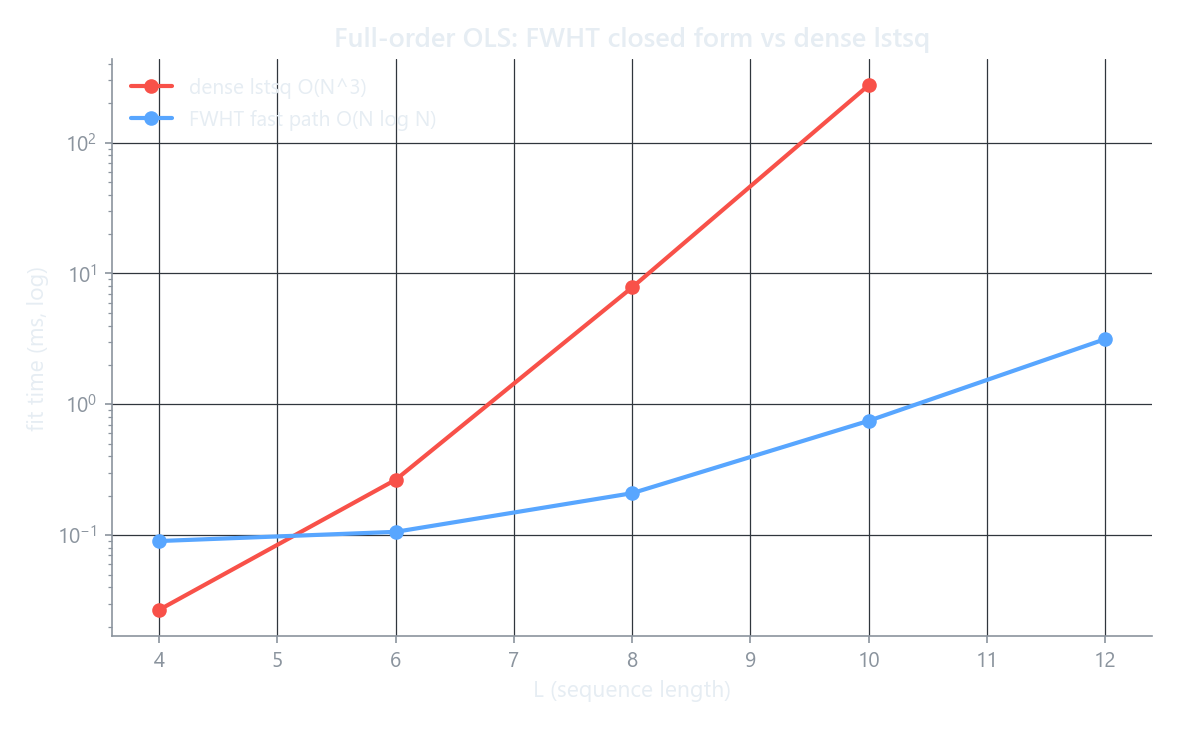
The FWHT path returns coefficients identical to the dense least-squares solve (to floating-point tolerance) while avoiding the n x n design matrix entirely, which is what makes the full-order speedups below possible.
Note
You rarely need to call this function directly. EpistasisLinearRegression.fit() automatically engages the fast path when the attached GPM satisfies the conditions below. The function is exposed as a public utility for benchmarking and custom pipelines.
When the fast path engages
EpistasisLinearRegression.fit() checks four conditions before invoking fwht_ols_coefficients. If any condition fails the function returns None and the standard sklearn least-squares path runs unchanged.
model_type must be 'global'
The Hadamard transform is only valid for global (Hadamard) encoding where 0 -> +1 and 1 -> -1. Passing any other model_type string returns None immediately.
Complete biallelic library: n == 2^L
Every distinct bit pattern across L positions must be present exactly once. The check computes genotype bitmasks and verifies they cover [0, 2^L) bijectively. Partial libraries, duplicate genotypes, and multi-allelic positions all return None.
Full order: exactly 2^L interaction sites
The sites list must contain exactly 2^L entries with distinct bitmasks that also cover [0, 2^L) bijectively. Any truncated order (e.g., fitting only up to order 3 on an L = 12 library) returns None.
n_bits in [1, 62]
Libraries larger than 2^62 are not supported (and do not fit in memory). Zero-bit inputs are rejected as degenerate.
Performance
The table below shows measured fit times from benchmarks/vs_v1.py on a Windows 11 workstation comparing v2 FWHT against dense numpy.linalg.lstsq.
| L | Genotypes | Dense lstsq | FWHT fast path | Speedup |
|---|---|---|---|---|
| 8 | 256 | 195 ms | 1.75 ms | ~111x |
| 10 | 1,024 | 3,005 ms | 3.10 ms | ~969x |
| 12 | 4,096 | 59,344 ms | 8.97 ms | >6,000x |
| 14 | 16,384 | hours | 35.50 ms | |
| 16 | 65,536 | hours | 154.15 ms |
The speedup is asymptotic: dense OLS scales as O(n^3) in the solve step while FWHT scales as O(n log n).
Tip
Memory also scales favorably. Dense OLS allocates an n x n float64 design matrix; at L = 16 that is roughly 32 GB. The FWHT path allocates only a handful of float64 vectors.
Rust kernel
The inner butterfly transform is implemented in Rust as epistasis._core.fwht:
The kernel runs an iterative in-place butterfly on the input vector and returns a new float64 array of the same length. fwht_ols_coefficients calls it once and divides by n to recover the Walsh-Hadamard coefficients.
fwht_ols_coefficients
binary_packed(np.ndarray, required)- uint8 array of shape
(n, n_bits)with values in{0, 1}. Must represent a complete combinatorial biallelic library:n == 2 ** n_bitswith every distinct bit pattern present exactly once. Obtain this fromgpm.binary_packed. y(np.ndarray, required)- float64 phenotype array of shape
(n,). Row order must matchbinary_packed. sites(Sequence[Site], required)- Interaction sites in the same order used by the design matrix. Must contain exactly
2 ** n_bitsentries whose bitmasks cover[0, 2^n_bits)bijectively (full order). Obtain viaencoding_to_sitesfromepistasis.mapping. model_type(str, default"global")- Encoding type. Only
"global"is supported; any other value returnsNonewithout raising. - Returns (
np.ndarray[float64] | None) - Coefficient array of shape
(len(sites),)in the same order assites, orNonewhen the fast path does not apply. WhenNoneis returned, fall back to your preferred dense solver.
Direct usage example
import numpy as np
from epistasis.fast import fwht_ols_coefficients
from epistasis.mapping import encoding_to_sites

# Assume `gpm` is a GenotypePhenotypeMap with a complete L=10 biallelic library
binary_packed = gpm.binary_packed          # shape (1024, 10), dtype uint8
y = gpm.phenotypes.astype(np.float64)      # shape (1024,)
sites = encoding_to_sites(10, gpm.encoding_table)  # 1024 sites for full order at L=10

beta = fwht_ols_coefficients(binary_packed, y, sites, model_type="global")

if beta is None:
    print("Fast path did not apply; use a dense solver.")
else:
    print(f"Solved {len(beta)} coefficients via FWHT")
    print(f"Intercept (site 0): {beta[0]:.6f}")
Using via EpistasisLinearRegression
The most common way to benefit from the fast path is to attach a full GPM and call fit() with no arguments. The fast path engages automatically when conditions are met, and you can verify it engaged by checking that standard errors are NaN (the system is exactly determined and (X'X)^{-1} is not computed).
from epistasis.models.linear import EpistasisLinearRegression

model = EpistasisLinearRegression(order=10)  # full order for L=10
model.add_gpm(gpm)
model.fit()  # FWHT fast path engages automatically for full biallelic libraries

# Standard errors are NaN for exactly-determined FWHT fits
print(model.epistasis.stdeviations)

# predict and score work normally through the sklearn composition boundary
r2 = model.score()
print(f"R^2 = {r2:.4f}")