EpistasisLinearRegression: OLS fitting
EpistasisLinearRegression is the simplest and fastest way to decompose a genotype-phenotype map into epistatic coefficients. It performs ordinary least squares over the epistasis design matrix and writes analytic coefficient standard errors directly into model.epistasis.stdeviations. For complete biallelic libraries encoded with the global (Hadamard) scheme, the model automatically engages a Walsh-Hadamard fast path that scales as O(n log n) instead of O(n^2), up to 6000x faster than the full matrix solve.
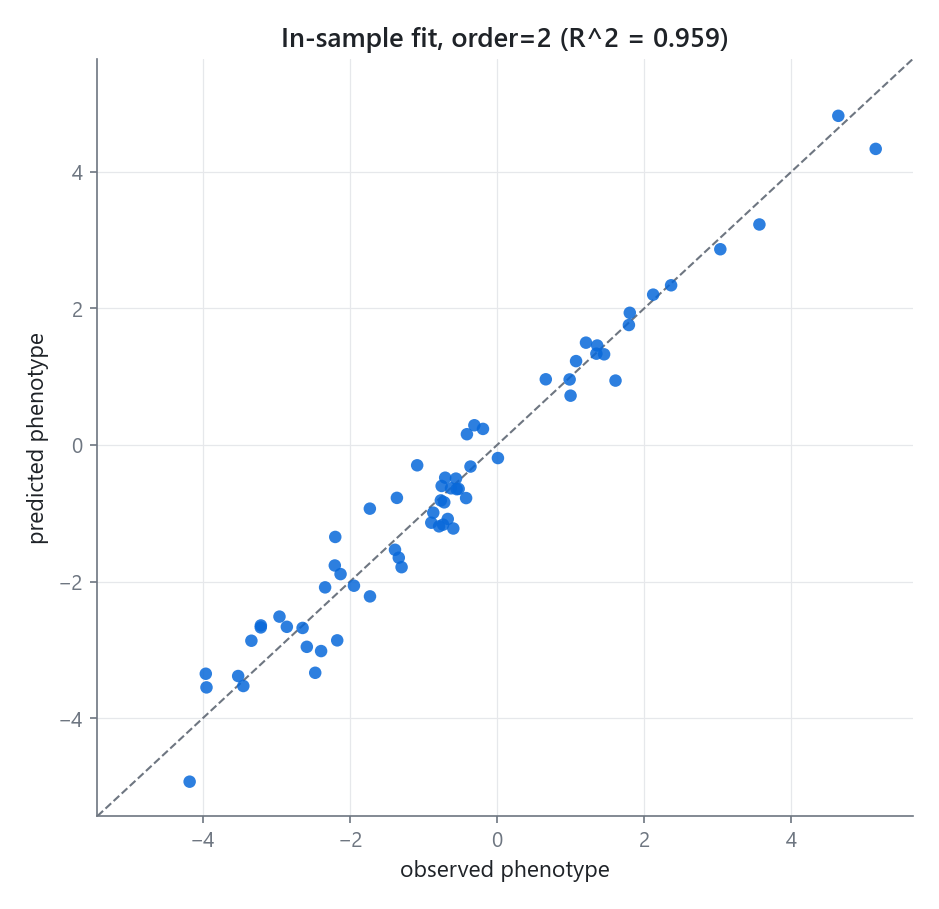
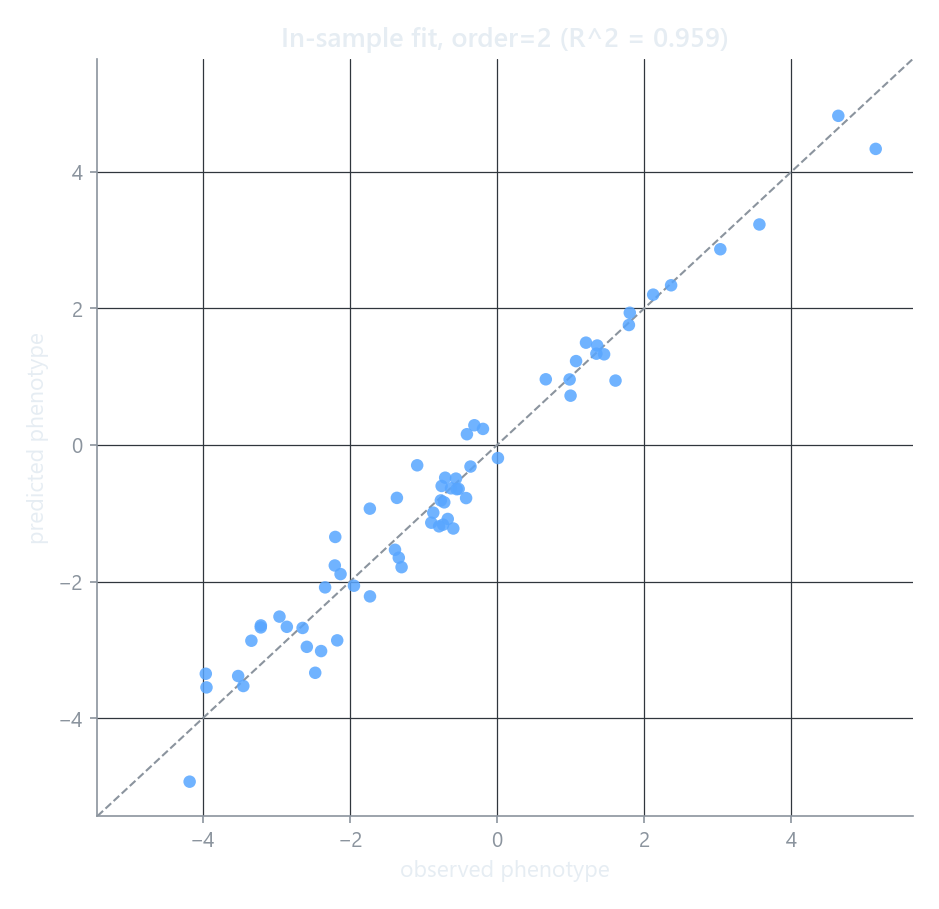
A well-specified model reproduces the held-out phenotypes closely: observed versus predicted values fall along the dashed 1:1 line. This is the diagnostic epistasis.pyplot.plot_correlation draws for you.
Constructor parameters
order(int, default1)- Maximum interaction order to fit.
order=1gives the additive model;order=2adds pairwise interactions; and so on up to the length of the sequence. model_type(str, default"global")- Encoding for the design matrix.
"global"uses the Walsh-Hadamard (Hadamard) encoding, which supports the fast path and is the standard choice for most analyses."local"uses the biochemical (local) encoding. n_jobs(int | None, defaultNone)- Number of parallel jobs forwarded to the underlying sklearn
LinearRegressionsolver.Noneuses one job;-1uses all available cores.
Workflow
-
Construct the model
Pass the desired interaction order and encoding type to the constructor.
-
Attach a genotype-phenotype map
Call
add_gpmwith aGenotypePhenotypeMapobject. This builds theEpistasisMapand caches the column layout for the design matrix. -
Fit
Call
fit()with no arguments to use the phenotypes stored in the attached GPM. Pass explicitXandyarrays to override. -
Inspect coefficients
Read fitted epistatic coefficients and their standard errors from the
EpistasisMap.
Key methods
fit(X=None, y=None)
Fit the model to the data. When both X and y are None, the method pulls phenotypes from the attached GPM and, where eligible, uses the Walsh-Hadamard fast path. You can pass:
None: use the GPM's genotypes and phenotypes (recommended)- A 2D NumPy array: treated as a pre-built design matrix
- A 1D array or list of genotype strings: converted to a design matrix automatically
Returns self so calls can be chained.
predict(X=None)
Predict phenotypes. Accepts the same X forms as fit. Returns a 1D np.ndarray of predicted phenotype values.
score(X=None, y=None)
Return the R^2 coefficient of determination between predicted and observed phenotypes.
hypothesis(X=None, thetas=None)
Compute X @ thetas without modifying any stored state. Useful for exploring how predicted phenotypes change under alternative coefficient vectors.
Key attributes
| Attribute | Type | Description |
|---|---|---|
model.thetas |
np.ndarray \| None |
Fitted coefficients array, set after fit(). |
model.coef_ |
np.ndarray |
Alias for model.thetas; provided for sklearn API parity. |
model.epistasis |
EpistasisMap |
Map of epistatic sites to fitted values and standard errors. |
model.epistasis.values |
np.ndarray |
Fitted coefficient per site, written by fit(). |
model.epistasis.stdeviations |
np.ndarray |
Analytic OLS standard error per coefficient. |
Complete example
import gpmap
from epistasis.models.linear import EpistasisLinearRegression

# Build a genotype-phenotype map (replace with your own data).
gpm = gpmap.GenotypePhenotypeMap(
    wildtype="AA",
    genotypes=["AA", "AB", "BA", "BB"],
    phenotypes=[1.0, 1.5, 1.8, 2.6],
)

# Fit a second-order (pairwise) epistasis model.
model = EpistasisLinearRegression(order=2, model_type="global")
model.add_gpm(gpm)
model.fit()

# Read results.
print("Epistatic coefficients:", model.epistasis.values)
print("Standard errors:       ", model.epistasis.stdeviations)

# Predict phenotypes for all genotypes in the GPM.
y_pred = model.predict()
print("Predictions:", y_pred)

# Evaluate goodness-of-fit.
r2 = model.score()
print(f"R^2: {r2:.4f}")
Walsh-Hadamard fast path
When you call fit() without supplying an explicit X, the model checks whether the library is eligible for the Walsh-Hadamard transform:
- The GPM must be complete (all 2^L genotypes present for a length-L binary sequence).
model_typemust be"global".ordermust equal the full sequence length (all interactions included).
When all three conditions hold, the fast path computes coefficients in O(n log n) time using fwht_ols_coefficients instead of solving the normal equations. For a fully connected 20-site landscape (2^20, about 1 million genotypes) this translates to a wall-time reduction from hours to seconds.
Note
When the fast path is engaged, the system is exactly determined (n observations, n parameters). Residuals are identically zero, so there are no degrees of freedom available to estimate σ^2. In this case model.epistasis.stdeviations is filled with NaN. Standard errors are only finite for overdetermined systems (more genotypes than parameters).