EpistasisGaussianProcess
EpistasisGaussianProcess classifies genotypes as viable or nonviable with a
Gaussian process classifier. Its draw over the other classifiers is calibrated
probability: rather than a hard boundary, it returns a smoothly varying
P(viable) with sensible uncertainty away from the training data. It uses the
same add_gpm -> fit -> predict workflow as every other epistasis model.
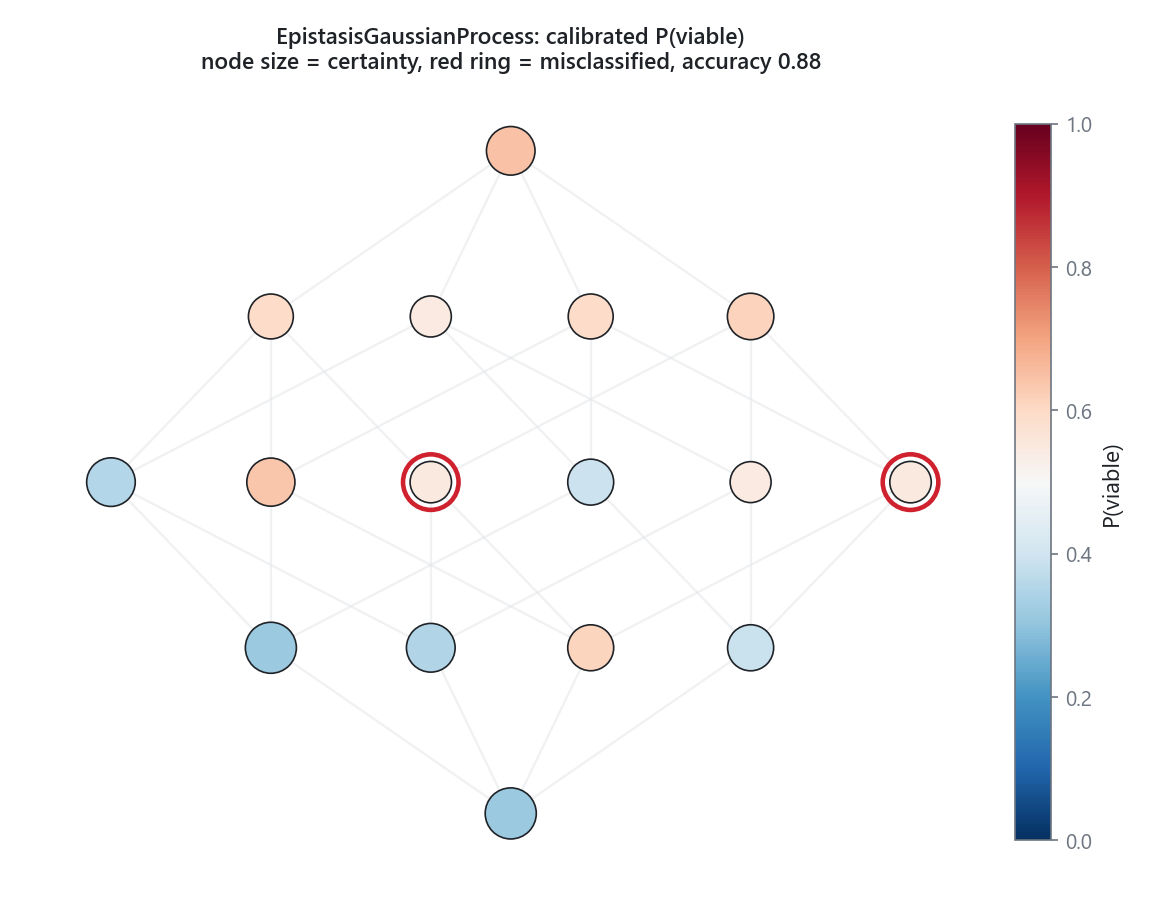
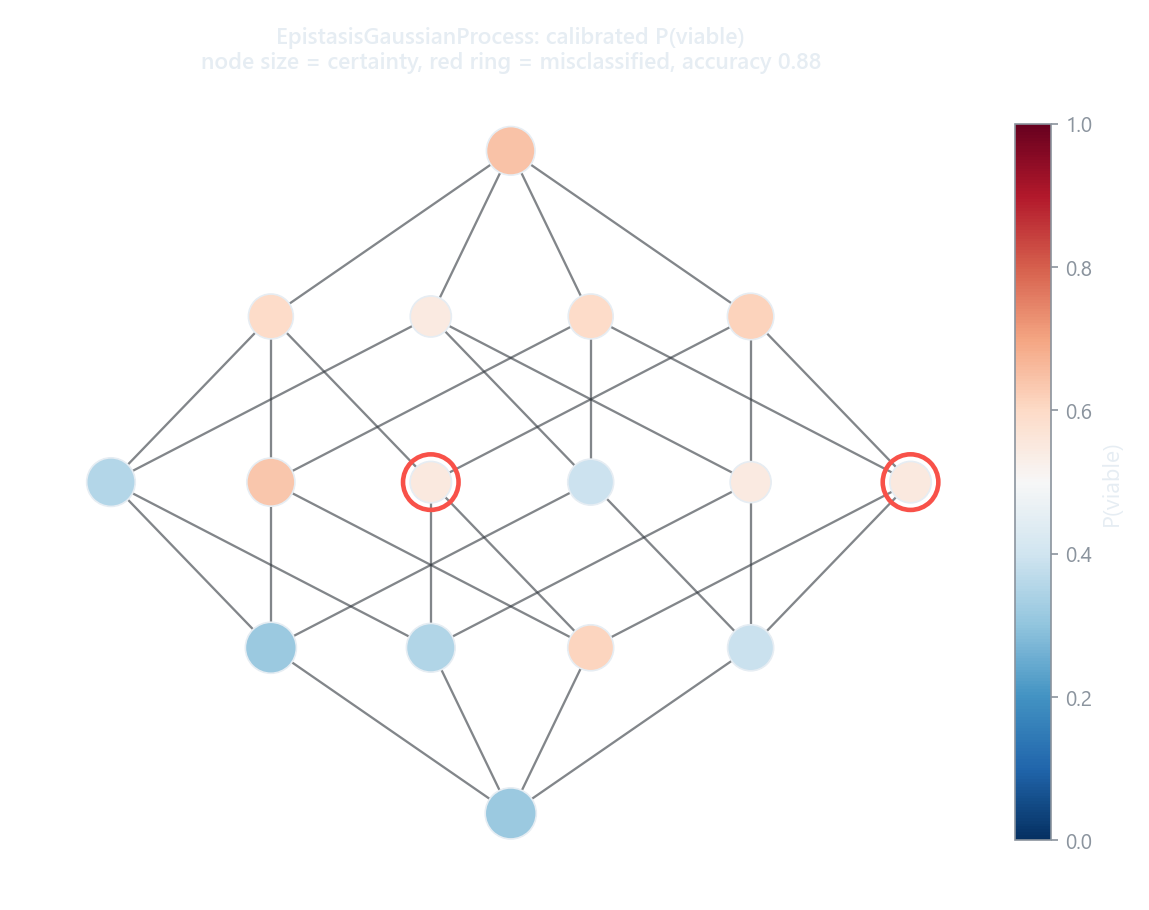
In the figure each node is a genotype colored by P(viable) and sized by how
certain the model is (|p - 0.5|); genotypes near the decision boundary stay
small and pale, which is exactly the calibrated-uncertainty behavior a GP buys you.
When to use this model
Use EpistasisGaussianProcess when you want probability estimates you can trust as
probabilities (for ranking, thresholding at a chosen risk level, or propagating
uncertainty) rather than just a class label. It is the most expensive classifier
here because fitting optimizes kernel hyperparameters, so prefer it on small to
medium libraries.
How it works
- An order-1
EpistasisLinearRegression(model.additive) learns each mutation's additive contribution from the continuous phenotypes. - The design-matrix columns are scaled by those additive coefficients.
- sklearn's
GaussianProcessClassifier(RBF kernel by default) is fit on the projected matrix with binarized labels (y > threshold -> 1).
Constructor parameters
threshold(float, required)- Phenotype cut-off. Genotypes above it are class 1 (viable).
model_type(str, default"global")- Design-matrix encoding:
"global"(Hadamard) or"local"(biochemical). kernel(sklearn.gaussian_process.kernels.Kernel | None, defaultNone)- Covariance kernel. Defaults to an
RBF()kernel. Pass your own to encode different smoothness assumptions. n_restarts_optimizer(int, default0)- Number of restarts for the kernel-hyperparameter optimizer. Raise it for a more thorough (slower) fit.
max_iter_predict(int, default100)- Iterations for the Laplace approximation used at prediction time.
random_state(int | None, defaultNone)- Seed for reproducible optimization.
Workflow
import numpy as np
from epistasis.models.classifiers import EpistasisGaussianProcess

model = EpistasisGaussianProcess(
    threshold=float(np.median(gpm.phenotypes)),
    random_state=0,
)
model.add_gpm(gpm)
model.fit()

p_viable = model.predict_proba()[:, 1]  # calibrated P(viable)
labels = model.predict()                # 0 / 1
accuracy = model.score()
Key methods
| Method | Returns | Description |
|---|---|---|
fit(X=None, y=None) |
self |
Fit the additive model then the GP classifier. |
predict(X=None) |
np.ndarray[int] |
Predicted class labels (0 or 1). |
predict_proba(X=None) |
np.ndarray[float] |
Calibrated class probabilities, shape (n_genotypes, 2). |
predict_log_proba(X=None) |
np.ndarray[float] |
Log class probabilities (falls back to log(predict_proba)). |
score(X=None, y=None) |
float |
Classification accuracy. |
See also EpistasisLogisticRegression,
discriminant analysis, and
EpistasisGaussianMixture.