EpistasisMonotonicGE
EpistasisMonotonicGE fits the nonlinear scale as a sum of K tanh sigmoids with
non-negative coefficients, which makes the scale monotone by construction. It
follows Tareen et al. 2022 (MAVE-NN, Genome Biology 23:98) and is the modern,
identifiable alternative to EpistasisPowerTransform: the
monotonicity constraint removes the sign ambiguity that hits unconstrained
global-epistasis fits. It is a concrete subclass of
EpistasisNonlinearRegression.
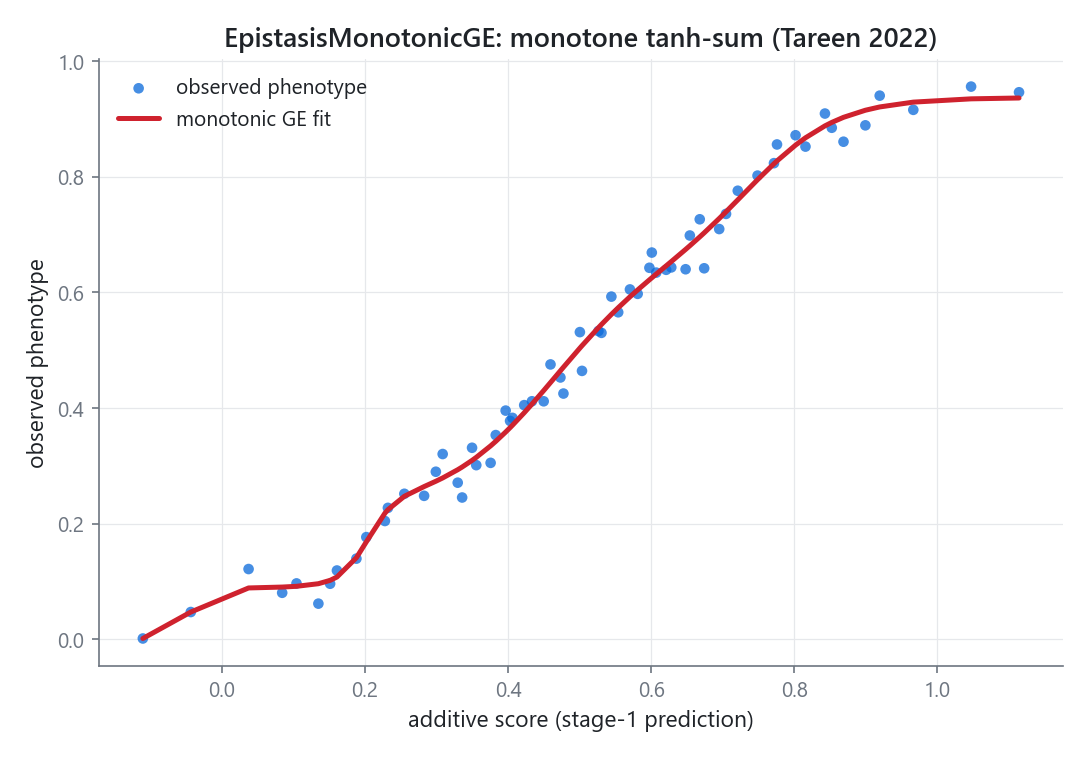
The fitted curve is guaranteed non-decreasing, so a higher additive score never
maps to a lower predicted phenotype. With enough sigmoids (K) it can still
capture sharp saturation, but it can never produce the spurious dips that an
unconstrained or spline fit might.
When to use this model
Use EpistasisMonotonicGE when you believe the measurement scale is monotone (more
additive signal never reduces the measured phenotype) and you want an identifiable,
flexible fit. It is the recommended default for global-epistasis modeling when the
power transform's specific shape is too rigid but a spline is too
unconstrained.
How it works
The same two-stage fit as EpistasisNonlinearRegression: an order-1 additive model
produces a per-genotype additive score, then a sum of K tanh sigmoids,
f(x) = sum_k a_k * tanh(b_k * x + c_k) with b_k, c_k >= 0, is fit mapping the
additive score to the observed phenotypes. The non-negativity constraints are what
guarantee monotonicity and identifiability.
Constructor parameters
K(int, default5)- Number of tanh sigmoids in the sum. More sigmoids can represent sharper saturation at the cost of more parameters.
monotonic(bool, defaultTrue)- Enforce the non-negativity constraints that make the scale monotone. Set
Falseto relax them (rarely needed). model_type(str, default"global")- Encoding for the additive design matrix:
"global"(Hadamard) or"local". seed(int | None, default0)- Seed for the optimizer's parameter initialization.
Workflow
from epistasis.models.nonlinear import EpistasisMonotonicGE

model = EpistasisMonotonicGE(K=5, monotonic=True, model_type="global")
model.add_gpm(gpm)
model.fit()

y_pred = model.predict()
y_linear = model.transform()
r2 = model.score()
Key methods and attributes
| Member | Description |
|---|---|
fit(X=None, y=None) |
Two-stage fit: additive model, then the monotone tanh-sum scale. |
predict(X=None) |
Predicted phenotype on the observed scale. |
transform(X=None, y=None) |
Observed phenotypes projected back onto the additive scale. |
score(X=None, y=None) |
Pearson R^2 between observed and predicted. |
model.minimizer |
MonotonicGEMinimizer; holds the fitted sigmoid parameters. |
See the two-stage fitting guide,
EpistasisPowerTransform, and EpistasisSpline.