EpistasisSpline
EpistasisSpline fits a smoothing spline as the nonlinear scale between the
additive genetic score and the observed phenotype. Where
EpistasisPowerTransform assumes a specific parametric shape,
the spline can follow an arbitrary smooth scale, including non-monotonic ones.
It is a concrete subclass of EpistasisNonlinearRegression backed
by scipy.interpolate.UnivariateSpline.
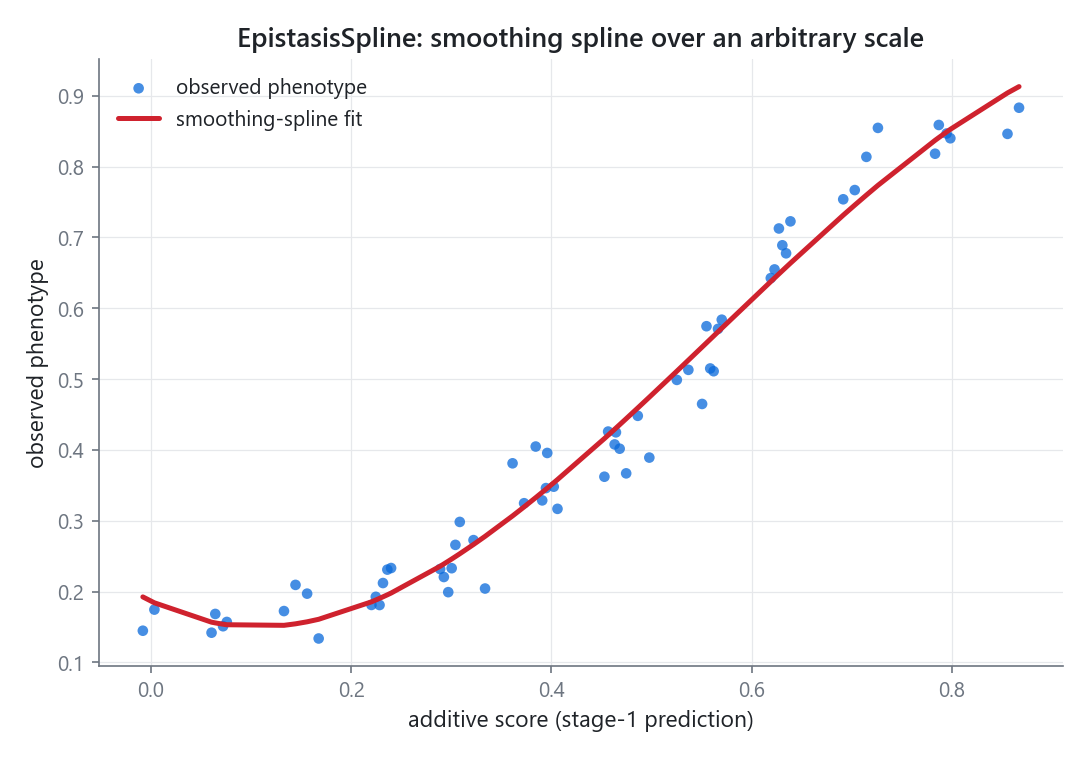
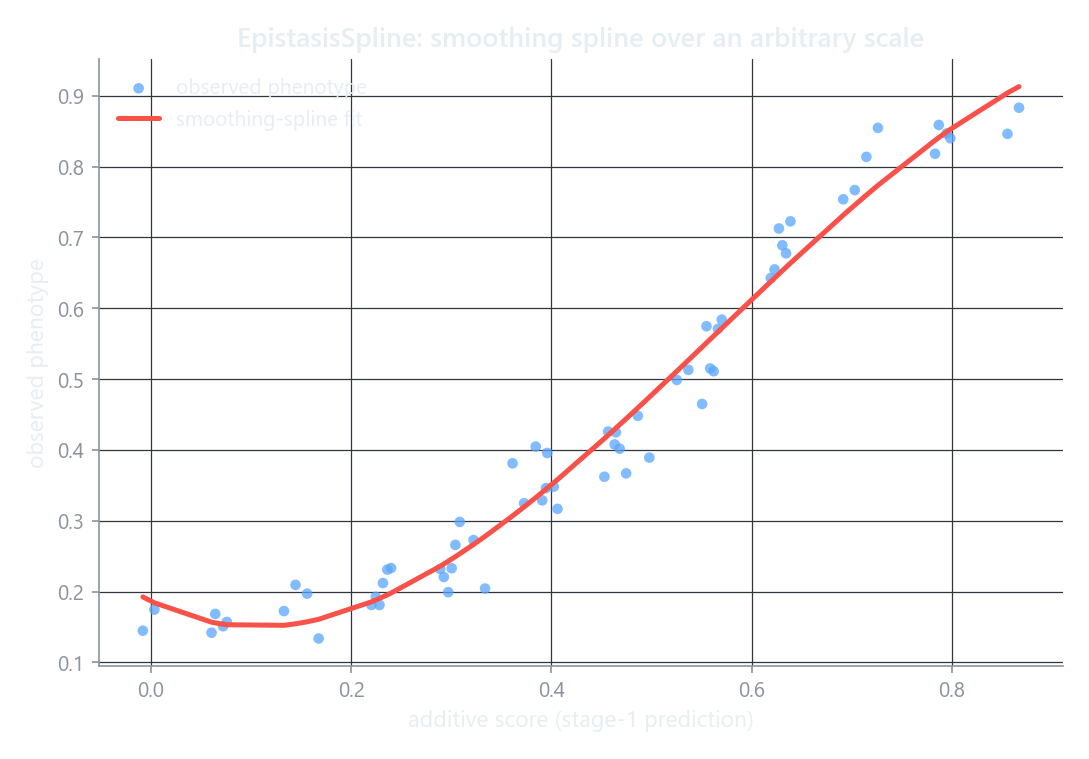
The example scale dips before rising again. A power transform could not capture that shape, but the spline tracks it. The trade-off is that the spline is not monotone by construction, so it can chase noise if under-smoothed.
When to use this model
Use EpistasisSpline when the measurement scale is smooth but its functional form
is unknown or non-monotonic, and you would rather let the data choose the shape
than commit to a parametric transform. If you know the scale is monotone, prefer
EpistasisMonotonicGE or
EpistasisPowerTransform, which cannot produce a spurious
wiggle.
How it works
The same two-stage fit as EpistasisNonlinearRegression: an order-1 additive model
produces a per-genotype additive score, then a univariate smoothing spline is fit
mapping the additive score to the observed phenotypes. Duplicate x-values get
deterministic jitter so the spline solver stays well-posed.
Constructor parameters
k(int, default3)- Spline degree.
3is a cubic smoothing spline. s(float | None, defaultNone)- Smoothing factor passed to
UnivariateSpline. Smaller values follow the data more closely (and risk overfitting); larger values smooth more.Nonelets scipy choose from the data. model_type(str, default"global")- Encoding for the additive design matrix:
"global"(Hadamard) or"local". seed(int | None, default0)- Seed for the deterministic jitter applied to duplicate x-values.
Workflow
from epistasis.models.nonlinear import EpistasisSpline

model = EpistasisSpline(k=3, model_type="global")
model.add_gpm(gpm)
model.fit()

y_pred = model.predict()
y_linear = model.transform()
r2 = model.score()
Key methods and attributes
| Member | Description |
|---|---|
fit(X=None, y=None) |
Two-stage fit: additive model, then the smoothing spline. |
predict(X=None) |
Predicted phenotype on the observed scale. |
transform(X=None, y=None) |
Observed phenotypes projected back onto the additive scale. |
score(X=None, y=None) |
Pearson R^2 between observed and predicted. |
model.minimizer |
SplineMinimizer; wraps the fitted UnivariateSpline. |
See the two-stage fitting guide,
EpistasisPowerTransform, and
EpistasisMonotonicGE.