EpistasisPowerTransform
EpistasisPowerTransform is a ready-made nonlinear epistasis model: it fits a
Box-Cox-style power transform as the scale between the additive genetic score and
the observed phenotype. It is the Sailer and Harms (2017) global-epistasis model,
and a concrete subclass of EpistasisNonlinearRegression with the
nonlinear function already supplied, so you do not pass a function of your own.
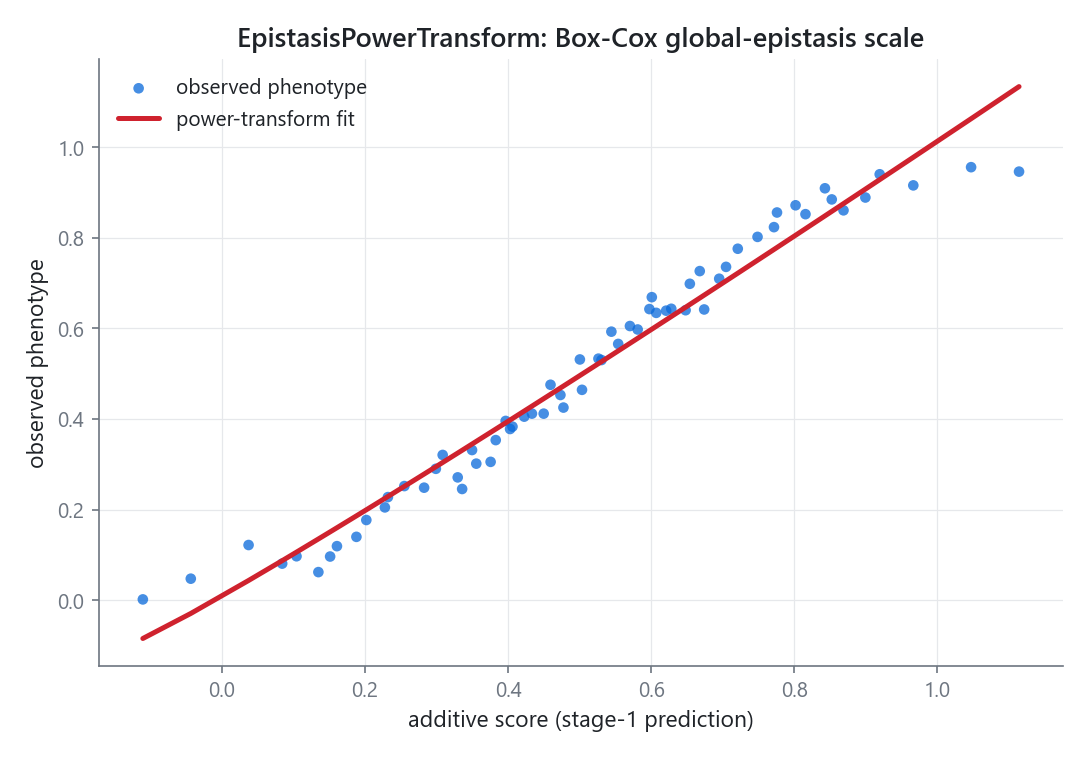
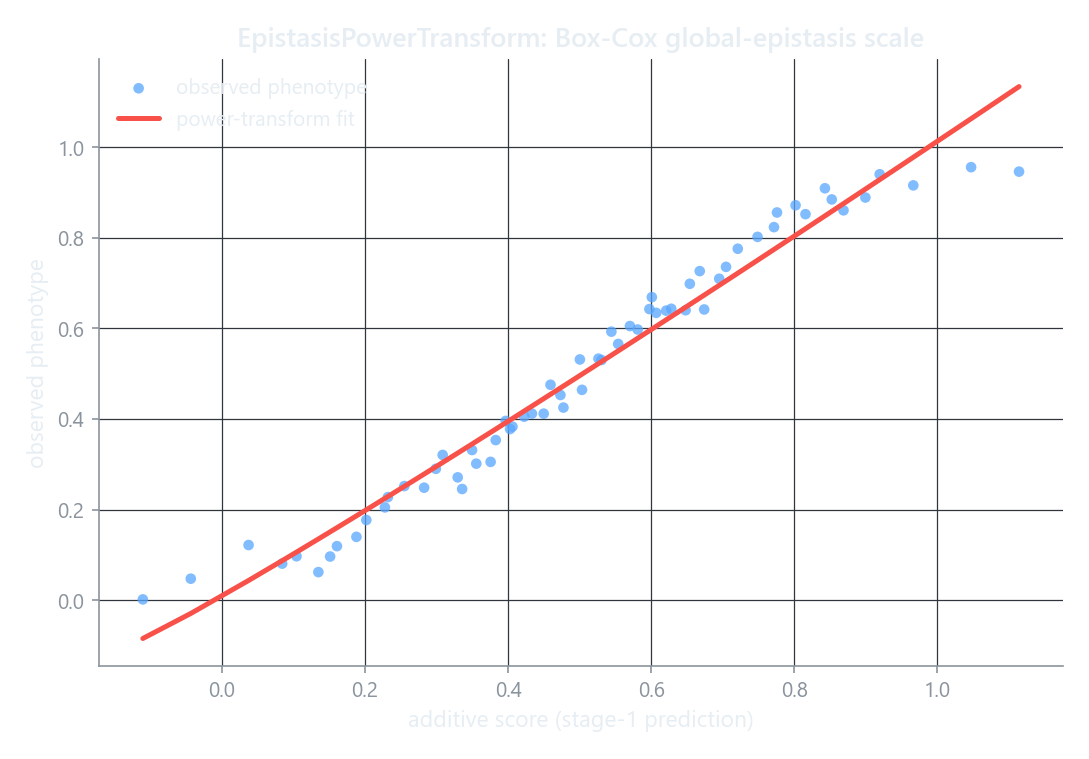
The fitted red curve is the learned scale: it maps the stage-1 additive prediction (x-axis) to the observed measurement scale (y-axis), absorbing the global nonlinearity so the additive coefficients underneath stay interpretable.
When to use this model
Use EpistasisPowerTransform when you believe the measurement scale is a smooth,
monotonic power-law-like distortion of an underlying additive landscape, and you
want a parametric, identifiable transform rather than hand-writing one for
EpistasisNonlinearRegression. For non-monotonic or otherwise
arbitrary scales, use EpistasisSpline; for a monotone neural-style
scale, use EpistasisMonotonicGE.
How it works
It runs the same two-stage fit as EpistasisNonlinearRegression: an order-1
additive model produces a per-genotype additive score, then the power transform
f(x; lmbda, A, B) is fit so that f(additive.predict()) matches the observed
phenotypes. The training-set geometric-mean reference is locked at fit time, so
predictions on new genotypes reuse the same scale.
Constructor parameters
model_type(str, default"global")- Encoding for the additive design matrix:
"global"(Hadamard) or"local". lmbda,A,B(float | None, defaultNone)- Optional fixed values for the power-transform parameters. Leave as
Noneto fit them; set one to hold it constant.
Workflow
from epistasis.models.nonlinear import EpistasisPowerTransform

model = EpistasisPowerTransform(model_type="global")
model.add_gpm(gpm)
model.fit()

y_pred = model.predict()         # phenotype on the observed (nonlinear) scale
y_linear = model.transform()     # phenotypes linearized onto the additive scale
r2 = model.score()
additive_coefs = model.additive.epistasis.values
Key methods and attributes
| Member | Description |
|---|---|
fit(X=None, y=None) |
Two-stage fit: additive model, then the power transform. |
predict(X=None) |
Predicted phenotype on the observed scale. |
transform(X=None, y=None) |
Observed phenotypes projected back onto the additive scale. |
score(X=None, y=None) |
Pearson R^2 between observed and predicted. |
model.additive |
The internal order-1 EpistasisLinearRegression. |
model.minimizer |
PowerTransformMinimizer; holds the fitted scale parameters. |
See the two-stage fitting guide for the shared mechanics,
EpistasisSpline, and EpistasisMonotonicGE.